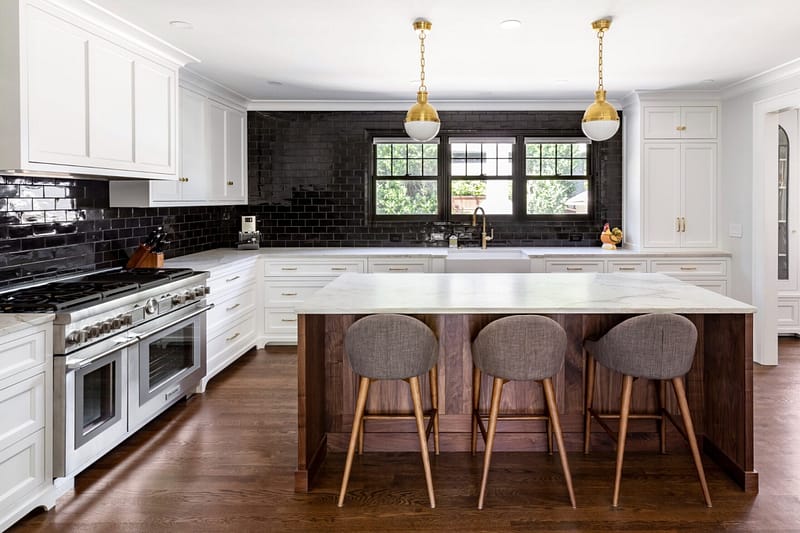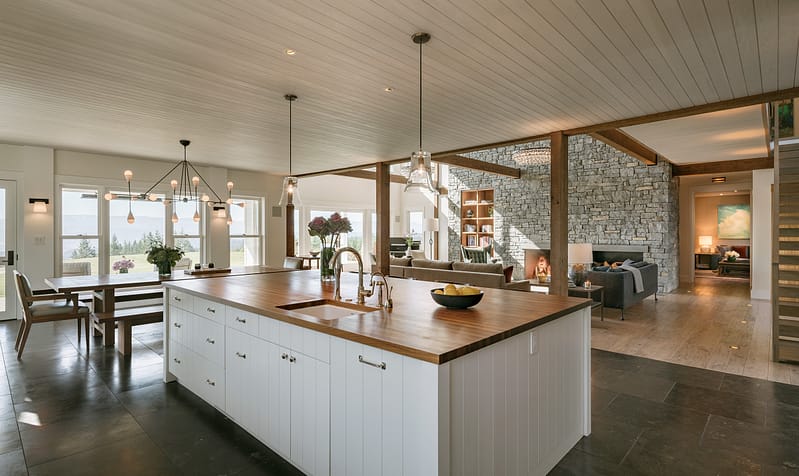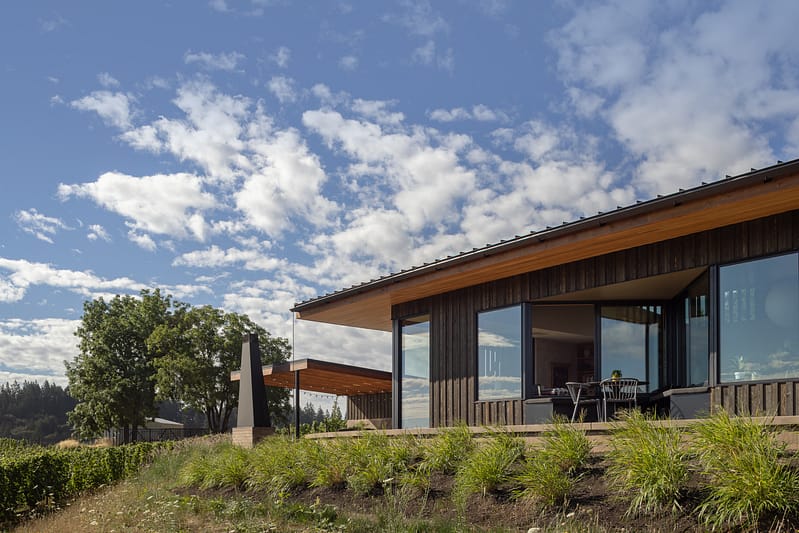

Check out our karuna house portfolio page
Original Title: Passive House showcase: Holst Architecture and Hammer & Hand team-up to build the Karuna House.
Original Author: Zack Semke
Originally Posted on: September 29th, 2011
Ambitious project aims for Passive House, Minergie, & LEED certifications.
Hammer & Hand is collaborating with the award-winning Portland firm Holst Architecture on a home in the vineyards of Yamhill County, Oregon that promises to become a national model of green building. (These beautiful digital renderings of the project come courtesy of Holst.)

View of Karuna House from Southeast – rendering courtesy of Holst Architecture
The Karuna House, as the net-zero energy project is known, aims to meet the world’s most demanding green building certifications, including Passive House, Minergie-P-ECO, and LEED for Homes Platinum. Green Hammer, Intep LLC and Earth Advantage Institute will provide independent consultation on Passive House, Minergie and LEED requirements, respectively.

View of Karuna House from North – rendering courtesy of Holst Architecture

View of Karuna House courtyard – rendering courtesy of Holst Architecture
The project client, a leading proponent of smart climate policy and sound land use, wants to use the Karuna House as a case study to examine the ways that the leading green building certifications and standards complement one another and the ways that they conflict.

Aerial view of Karuna House – rendering courtesy of Holst Architecture
“It’s a great challenge,” says Sam Hagerman, Hammer & Hand’s co-owner and President of the national Passive House Alliance. “When you line up the various aims of the standards, like the superior energy performance of Passive House, the sustainable materials requirements of LEED, and the lifecycle concerns of Minergie-P-ECO, you’re left with a pretty narrow path to navigate through in design and construction. It’ll be an interesting journey, and one with pretty exciting environmental rewards, and lessons.”

Project development meetings at Holst Architecture’s office
We’ve just broken ground, so please stay tuned for updates from the field. It’s an exciting project, one that we’re really fortunate to be part of.
– Zack
Original Title: Karuna House excavation: the Passive House, Minergie, LEED Platinum project is underway
Original Author: Zack Semke
Originally Posted on: October 7th, 2011
Site photos offer a glimpse of the project’s green building design and construction strategies.
Construction on the Karuna House is underway! As I blogged recently, the project is a national green building case study based in Yamhill County, Oregon. Designed by Holst Architecture and built by Hammer & Hand, the house aims for Passive House, Minergie-P-ECO and LEED for Homes Platinum certification.
rendering courtesy of Holst Architecture
This morning lead carpenter Scott Gunter shared the team’s latest construction photos with me (thanks to Aaron Bergeson, Shelley Martin, and Scott for their pics) and talked through what’s going on in the field…

This shot shows the sweeping views of Yamhill County wine country commanded by the site.

Here we see excavation for the house underway. The gravel you see in piles is “3/4 minus” crushed rock, meaning it’s been sifted to contain crushed rock with diameter of no larger than 3/4″. This crushed rock will be used as the gravel base for the footings and slabs of the house. The team will lay a 3″ layer of the 3/4 minus, top that with a 1″ layer of 3/8 minus for fine grading, and then lay structural EPS Geofoam on that to super-insulate the foundation of the home to achieve the optimal energy performance required by the Passive House and Minergie standards.

It’s important to avoid site erosion during construction, both for LEED certification and to follow basic sound construction practice. This shot shows straw wattles snaking across the site to divert water and filter out sediments so that they remain onsite. The straw you see laid out across the ground mitigates surface erosion during rain storms; the rain hits the straw rather than the disturbed dirt surface.

The Karuna House will employ three different foundation strategies throughout the project: 1. slab on grade, 2. platform framing (essentially decking above a slab), and 3. full basement. Here we see excavation for a full basement portion of the house, with the 3/4 minus crushed rock at the base. The project team carefully planned excavation to balance “cut” and “fill” onsite, thereby eliminating the need to truck in imported fill. The heavy machinery pictured here sits on native structural fill (up to 3.5′ thick) built up from excavation cuts made elsewhere onsite. Money and carbon saved by avoiding fill transportation and import.

The structural fill is prepared in “lifts”, or sequentially-compacted layers, each 1′ thick. Here we see the “sheep’s foot” making a pass over one of the lifts, compacting the native fill to proper bearing capacity.

Here the Geotech engineer performs a probe test to verify the structural fill’s bearing capacity.

Key members of the project team have a meeting of the minds onsite. From left to right: Cory Hawbecker of Holst Architecture, Scott Gunter and Sam Hagerman of Hammer & Hand.

In this shot we see fine grading of the 3/8 minus in preparation for compaction.

Here carpenter Aaron Quint makes the final compacting touches on the layer of 3/8 minus. Note the little orange dot in front of Aaron. That’s the hub-and-tack survey mark showing the exact location of the corner of the future building.

This shot shows the orange string lines being pulled off the batter boards. The string lines, which demarcate wall location, form crosshairs directly above the hub-and-tack marks.

This view looking back across the site shows the EPS Geofoam awaiting installation. See this blog post for more about the foam.

Here’s the foam being loaded off the truck. It’s mostly air bubbles, so fairly easy to handle. The foam is pre-cut to the exact dimensions required for the house, so there will be very little waste. What little waste is generated will be recycled into new EPS products.

Here’s a close-up of the mountain of foam. Next up, installation of this EPS to sit under the footings and slabs of the house.
Stay tuned!
– Zack
Original Title: Karuna Passive House construction video – Hammer & Hand demonstrates geofoam foundation installation
Original Author: Zack Semke
Originally Posted on: October 20th, 2011
Key step in constructing foundation at Karuna is demonstrated by lead carpenter Scott Gunter, Aaron Quint & Aaron Bergeson.
Excavation was the topic of the day during our last post about the Karuna House. Today we’re on to the project’s super-insulated foundation.
(Note: the Karuna House is a national green building case study being constructed in Yamhill County, Oregon. Designed by Holst Architecture and built by Hammer & Hand, the house aims for Passive House, Minergie-P-ECO and LEED for Homes Platinum certification.)
A key principle of Passive House (as well as Minergie) design and construction is the concept of super-insulating the building envelope. And that includes not only the four walls and roof, but also the foundation. To that end, we’re using EPS geofoam at the Karuna House… we’re actually building the foundation on top of a thick layer of the stuff. Read here for more about why that’s a good idea.
Our own Skylar Swinford, Certified Passive House Consultant and a leading building scientist at Hammer & Hand, visited the Karuna site a few days ago with his video camera to interview lead carpenter Scott Gunter and document the process of installing the geofoam foundation. The clip also features Hammer & Hand’s Aaron Quint and Aaron Bergeson.
Grab some popcorn… the clip’s below.
– Zack
Original Title: Do the three green building standards at Karuna House conflict or complement?
Original Author: Zack Semke
Originally Posted on: October 27th, 2011
Navigating through Passive House, LEED, and Minergie-P-ECO territory.
I had the pleasure of speaking recently with Cory Hawbecker, designer at Holst Architecture, about the Karuna House and its certifications. We’re building the project to Passive House, Minergie-P-ECO, and LEED for Homes Platinum standards, and Cory is playing a lead role in navigating the project through the myriad of requirements. It’s a pretty unique task, perhaps the first time it’s ever been done.
“The client for the Karuna House wants to create a beautiful sustainable home that he can enjoy, of course. But he also sees the project as a learning tool for the building community,” Cory said. “The question we’re exploring is, ‘How do the green building certifications compare and how do they contrast?’ We hope that the lessons we learn will be helpful to designers and builders across the country.”
Here’s what we’ve discovered so far …
What’s special about Passive House – a singular focus on performance.
 The Passive House standard focuses entirely on building performance. It’s simple, and it doesn’t care how you achieve the performance. If your project achieves the required benchmarks for airtightness, energy demand and ventilation, then it’s certified. Period. The result of this singular focus? The Passive House standard achieves extraordinary energy performance gains. And the Passive House Planning Package’s modeling results correlate closely with real world performance once built, so the Passive House standard provides significant certainty that promised performance gains will be realized.
But this singular focus on building performance opens the standard to critique from those who ask, “What about the embodied energy of materials? Or toxicity of materials? Or location of site? Or access to transit? Or use of native plants?”
It’s true that these broader sustainability questions are not addressed by the standard. Passive House practitioners counter in two ways:
- First, the most pressing problem that we need to address in our buildings is their contribution to global climate change. After all, well over 40% of US greenhouse gas emissions come from the building sector. So Passive House’s intensive focus on building energy performance makes sense.
- Second, while the standard intentionally ignores broader questions of sustainability, Passive House designers and builders themselves do address them as they develop a project. Those efforts just aren’t recognized by the Passive House standard itself.
Still, there’s no question that Passive House doesn’t consider broader sustainability questions. It’s intentional: a singular focus on performance.
What’s special about LEED – a broad spectrum of sustainability.
 LEED, on the other hand, doesn’t focus its attention in one area but instead works to address a broad spectrum of sustainable design and construction concerns. In many ways it’s the complementary opposite of Passive House. And while some elements of the standard are performance-based, much of it is comprised of prescriptive elements, grouped into a comprehensive system of checklists that address things like embodied energy, toxicity, site selection, access to transit, use of native plants, and much more.
But LEED’s broad scope opens the standard to critique from those who ask, “What about energy performance? How can you call a building “Platinum” if its energy use is only marginally better than a similar building built to code?” Historically, LEED buildings have fallen short in reducing energy consumption.
Proponents of LEED will say that the US Green Building Council (the body that created and oversees LEED) is addressing this once-blind spot. Progress has been made recently, and there are even discussions about making Passive House the energy performance component of LEED, which could be very powerful.
But there’s no question that the effort to address a broad range of sustainability questions has made it more difficult, at least in the past, for LEED to focus effectively on building performance.
So what about Minergie-P-ECO? And what do the “P” and the “ECO” mean?
 Chances are you haven’t heard of Minergie before. It’s a pretty recent Swiss import, and the Karuna House will be one of the first structures to gain Minergie certification in the US (if all goes well).
According to Cory, Minergie started in Switzerland as part of an effort to make energy efficient buildings accessible to a mass market, much like ENERGY STAR here in the US. Affordability is a prime component of the base level of Minergie, and energy performance is adequate, but hardly revolutionary.
However, when you add the “P” of Minergie-P, then you’ve got revolutionary energy performance. The “P” adds on a Passive House-like standard of building energy consumption. Some of the details of how Minergie-P is calculated are different from Passive House, but in the end the two standards are quite similar, both performance-based and both focused on big reductions in energy use.
The “ECO” is analogous to the broader sustainability concerns of LEED. It addresses things like site selection and embodied energy, but also adds a couple of unique foci, like limiting exposure of workers in the field to toxics, and safeguarding occupants’ experience of a building (going so far as to consider the noise of pipes in the walls).
In a sense, Minergie-P-ECO takes the complementary opposites of Passive House and LEED, revises them, and combines them into one comprehensive standard.
Lessons learned so far.
“While they do have different emphases, what we’re finding is that there’s a lot of alignment among the standards, which is good news,” Cory told me. “The energy performance of all three point in the same direction, though Passive House and Minergie-P exceed what LEED requires. And just as LEED is concerned with materials selection, so is Minergie-ECO.”
That’s not to say it’s easy to achieve Passive House, LEED Platinum and Minergie-P-ECO in one project. Here are a few challenges we’ve encountered in the early stages:
- Site selection. Because the Karuna House is being built on the client’s vineyard in Yamhill County, it’s penalized by LEED for being a green field and for not being part of an existing neighborhood. Fortunately, because the energy performance of the house is so advanced, the LEED credits gained in that category will offset the credits missed due to the home’s location.
- No site-applied spray foam. Minergie-ECO prohibits site-applied foam, even one component products because it can expose the installer to fire retardants and catalysts if proper safety equipment isn’t used. The initial design of the Karuna House incorporated spray foam insulation. We switched to high density cellulose insulation, which is not only non-toxic but also scores high marks for its low embodied energy and low global warming potential. Still, one-component spray foam is a handy gap filler and adhesive, (spray foam should never be relied on as an air-barrier in a Passivhaus), so Minergie-ECO’s prohibition on the stuff adds challenges. To fill gaps between materials we’re now using acrylic impregnated expanding foam tape, for instance. T ighter tolerances and precision cuts from our skilled carpenters also reduce the need for one-component foam.
- No treated lumber. This is a conflict between Minergie-ECO and state building code. Due to toxicity concerns, Minergie-ECO doesn’t allow treated lumber inside the air barrier of a building, and encourages builders to avoid it outside the air barrier as well. The typical code-compliant method of building structural walls involves laying down a pressure-treated wooden sill plate on top of the concrete foundation, creating a buffer that protects framing lumber from the moisture given off by the concrete. Without the plate, mold, rot, and bugs can wreak havoc on framing. Our Minergie-friendly workaround? Use a borate treated sill plate installed over a structural epdm gasket to separate the wood from the concrete.
- No hood exhaust, no dryer exhaust. Code requires hood exhaust units in kitchens, which takes warm inside air and dumps it outside. Because it’s a huge source of energy loss, neither Passive House nor Minergie-P allow this approach. The workaround is to locate the heat recovering ventilation (HRV) system for the building near the kitchen, and to use a recirculating fan with charcoal filter to remove grease from exhaust air before it reaches the HRV. Similarly, Passive House and Minergie-P preclude conventional dryer vents. Our solution at Karuna is to use a closed cycle heat pump clothes dryer.
We’re just at the first phases of construction, so new challenges and lessons are bound to come up. We’ll share them with you here as they arise. Thanks for reading!
– Zack
Original Title: Karuna House’s concrete on foam: Passive House innovation and simplicity
Original Author: Zack Semke
Originally Posted on: December 3rd, 2011
Photos document Hammer & Hand’s straight-forward approach to a cutting-edge aspect of Passive House construction.
One of the most compelling aspects of Passive House construction is its emphasis on simplicity. The standard itself is simple: reach the required level of energy performance and your building can be certified.
And the means employed by Passive House designers and builders are simple, too: superinsulate, build airtight, avoid thermal bridges, use excellent doors and windows, mechanically ventilate with heat recovering ventilation, and optimize solar & heat gains through smart orientation and design.
The vanguard of 21st Century building is not about complex technology.
This illustration by the Boston firm Albert, Righter and Tittman Architects makes the point nicely. We’ve moved beyond a bunch of gadgetry and expensive mechanicals:
 What’s sophisticated about Passive House is the advanced building science that underpins it, enabling us to take simple strategies and, with the help of powerful modeling software, combine them into designs that achieves revolutionary energy savings at optimized cost. It’s this deep understanding of buildings that allows us to move past the “20th Century” approach at the center of the illustration above.
So, there’s nothing simplistic about Passive House. But, consistent with principles of good design that date back to the Renaissance, the standard allows us to design and build elegantly simple, high performance structures.
The Karuna House isn’t just pursuing Passive House certification, but also LEED for Homes Platinum and Minergie-P-ECO. (See this Field Notes post about the three certifications.) But this drive for simplicity permeates the project team’s work, both by Holst Architecture at the design table and Hammer & Hand on the construction site.
“What we’re finding as we build Karuna,” Lead Carpenter Scott Gunter told me, “is that while we’re definitely doing ‘outside the box’ stuff out there, we’re drawing on straight-forward, time-tested construction techniques to make them happen.”
A case in point: in our last video installment about Karuna, Scott demonstrated how his team installed a layer of geofoam insulation that the future house will sit on. That’s certainly “outside the box” stuff. Not a lot of buildings have their foundations poured on top of a foot-thick layer of expanded polystyrene. (Yet.) But the basic techniques employed to accomplish the job – batter boards, plumb lines, leveling, screeding, compacting – would be familiar to any field carpenter.
 Hammer & Hand’s Aaron Bergeson and Scott Gunter carrying the EPS foam used to insulate Karuna’s underslab.
The same is also true for forming and pouring the foundation. Granted, in this case the foundation was poured on top of EPS geofoam, but Scott and his team used box form and plywood construction to do the job, standard practices taken directly from the production concrete playbook. So while we’re doing cutting-edge construction at Karuna, we hew to simple techniques whenever we can because they’re fast, cost-effective and proven.
A word about the concrete: in keeping with LEED and Minergie-ECO requirements, we’re using concrete made with a 30% fly ash mix and locally-sourced aggregate. Fly ash is a byproduct of coal combustion and can substitute for a portion of the Portland cement content of concrete. Given the high carbon emissions required to produce Portland cement, substituting with fly ash helps reduce the ecological footprint of concrete. Plus it diverts fly ash from landfills and reduces demand for the virgin materials that make up Portland cement.
Now on to the site photos. In addition to playing a key role in coordinating our team at Karuna, Hammer & Hand’s Shelley Martin is documenting construction progress on site. Scroll on for her photos and Scott’s notes…
 Installation of the geofoam insulation under the footings is underway.
 Here we see the formwork for the footings – standard box form construction.
 Another view of the formwork for the footings.
 In this shot the footings have been poured and a black capillary break material has been installed. Concrete likes to wick up water, so this capillary break will keep moisture from coming up through the footing and transferring into the stem wall and up into the floor slab. The blue material is the vapor barrier tied into the underslab insulation.
 This shot shows a broader view of the footings with the black capillary break installed on top.
 Here we see how the footings sit on top of a thick layer of EPS geofoam. (See this video for detail about the process.)
 This shot shows formwork for the foundation walls using standard plywood and box form construction.
 Here the footing and wall pour is complete, with concrete that has a 30% fly ash blend with local aggregate. The next step will be to roll on the waterproof air barrier, an emulsion made specifically for “green” (ie. not-yet-cured) concrete. We were able to apply the waterproof air barrier just 24 hours after stripping the forms – a nice timesaver.
 Here we see the footings and wall casts. As you can see, we’ve rolled the EPS foam up and around the footing and have applied the waterproofing to both the top of the footings and the stem wall.
 Aaron Quint examines the underslab insulation, 12” of EPS geofoam laid on a compacted gravel bed.
 Another shot of the underslab insulation, closer to completion.
Here the seams of the 15 mm air and vapor barrier are being taped. To the right, notice the black strip across the base. That’s a ½” thick layer of compressible felt that will act as an expansion joint to allow for concrete movement.
Stay tuned for new video this week. The crew’s been busy!
– Zack
Original Title: Karuna House concrete detailing and pour shown in site photos
Original Author: Zack Semke
Originally Posted on: December 15th, 2011
The Passive House, Minergie-P-ECO, LEED Platinum project is now officially “out of the dirt.”
Lead Carpenter Scott Gunter and Project Administrator Shelley Martin video-conferenced with me today from the job site in Yamhill County to share the latest progress at the Karuna House, the national green building case study designed by Holst Architecture and built by Hammer & Hand.
The team has been busy prepping and pouring the upper floor and basement concrete slabs. Scroll on for Shelley’s photos and Scott’s notes.
Upper floor slab pour
We start with the pour of the slab for the upper floor of the Karuna House…
 Here the blue air/vapor barrier is in place, hiding a thick layer of super-insulating EPS geofoam that lies underneath. As you can see at right, the blue barrier wraps up and over the stem walls, which are also clad in EPS foam. The rebar grid and formwork are ready and waiting for the concrete in this photo, taken just 10 minutes before the pour.
 This photo shows how the team dealt with pipe penetrations through the air/vapor barrier: everything taped with a butyl-based tape and coated with air-sealing mastic.
 Here the pump truck is pouring the concrete slab via its boom. We’re using the same LEED-friendly 30% fly ash concrete mix that we discussed in our last Karuna post, with the locally-sourced aggregate.
 Here’s a nice shot of the upper floor slab after the pour. Notice the under layer of EPS geofoam extending out beyond the slab and stem walls, insulating the future home from the heat-robbing ground.
Sill plate detailing
Next we move on to the sill plate details, showing how the team negotiated the transition from the concrete stem walls to the wood framed walls that will be built atop them…
 This shot shows a stem wall with the wood sill plates resting on the ground, waiting to be placed. Notice how the blue air/vapor barrier transitions right to the top of the stem wall. We’re using the same taping and mastic treatment for the penetration of the J bolts as we did for the pipe penetrations discussed earlier.
 This photo shows how the EPDM gasket has been applied to the bottom of the wood sill plate. This gasket will create an airtight seal between the bottom of the sill plate and the top of the stem wall.
In conventional construction, you’d instead use a pressure-treated sill plate here to interrupt moisture transfer from the concrete foundation wall to the wood framing above, with a layer of off-the-shelf sill sealer applied between the sill plate and the stem wall. No vapor/air barrier, no mastic, no EPDM gasket. But pressure treated lumber is prohibited by the Minergie-ECO standard, so that would be a no-no at Karuna. And because we have a vapor barrier enveloping the stem wall, there’s no moisture transfer from the stem wall and therefore no reason to use a pressure treated sill plate in the first place.
Here’s a detail of the sill plate installed atop the stem wall with the EPDM gasket providing the airtight seal.
Basement pour
In the final set of photos we’re on to preparations for the pour of the basement slab…
This shot shows the black capillary break material (discussed in our last Karuna post) applied atop the footing. The blue air/vapor barrier is aligned with the vertical pieces of the rebar for the stem wall. We cast the stem wall on top of this air/vapor barrier to create an airtight seal.
 In this shot the stem walls have been poured and the air/vapor barrier for the basement slab is taped and sealed. The trench that is visible along the left will create a thickened portion of the slab for a load-bearing wall. The vertical pipe and square bare patch on the right is for the basement’s sewage ejector pump. It will be an entirely self-contained, air-sealed and insulated system, completely isolated from the house.
 Here the rebar grid is ready for the pour.
 This shot shows the basement slab awaiting its pour, and the finished upper slab above. Concrete is nearly complete!
“Now we’re ready to start framing,” Scott told me. “We’re out of the dirt!”
– Zack
Original Title: Karuna Passive House – new video posted to new Karuna video gallery
Original Author: Zack Semke
Originally Posted on: December 21st, 2011
Scott Gunter walks us through the detailing of Passive House-friendly foundation footings in latest video installment from the field.
Please check out our brand new video about the construction of the Karuna House, “Foundation Footings: Karuna House Video #2”, narrated by Hammer & Hand lead carpenter Scott Gunter.
(Note: the Karuna House is a national green building case study being constructed in Yamhill County, Oregon. Designed by Holst Architecture and built by Hammer & Hand, the house aims for Passive House, Minergie-P-ECO and LEED for Homes Platinum certification. See this introductory post about the project.)
You’ll find the new video in our new gallery of Karuna House videos, included below and on our Karuna House page. Please check back for future updates – we plan several in coming days.
– Zack
Original Title: Karuna Passive House construction: phase one complete!
Original Author: Zack Semke
Originally Posted on: December 22nd, 2011
We review Karuna House progress in this video essay about the Passive House, Minergie, and LEED Platinum project.
It’s official! The first phase of Karuna House construction is complete: the Passive House/Minergie-P-ECO-friendly foundation is laid, the stem walls are up and we’re ready for framing. Out of the dirt!
The Karuna House, designed by Holst Architecture and built by Hammer & Hand, was conceived as a national green building case study by the project’s client. (See this introductory post about the project.) The team is pursuing Passive House, Minergie-P-ECO, and LEED for Homes Platinum certifications for the home. (See this post about the effort to achieve all three demanding certifications in one project.)
Rendering of the Karuna House, courtesy of Holst Architecture.
Throughout the construction process, Hammer & Hand’s Skylar Swinford and Scott Gunter have been busy shooting a series of videos to explain the building details and strategies employed to construct this high performance home. Now that we’re closing the first chapter of construction, I thought it’d be helpful to pull together those videos, as well as site photos by Shelley Martin, into a quick summary of what we’ve accomplished at Karuna so far.
LEED-compliant straw erosion control (l), basement excavation (c), and EPS foam delivered (r)
Geofoam Foundation Installation
Once excavation was complete, our first step was to lay the EPS (expanded polystyrene) geofoam foundation layer to insulate the concrete footings and slab from the ground. A key principle of Passive House and Minergie-P is to “super-insulate” all six sides of the building envelope. In this first video Scott talks through the steps our team took to prepare the foam layer.
These photos (below) show the pre-cut pieces of EPS being unloaded from the truck, and then placed.
Foundation Footings
The team then poured the foundation footings directly on top of the layer of geofoam. In this next video Scott points out the black capillary break material that coats the top of the footings to block moisture transfer up into the foundation stem walls. He also shows how the team will precisely align the wall forms.
These photos (below) show the various footing treatments across the site, all prepped with the capillary break material across the top.
Basement Foundation Walls
In this next video, Scott walks us through the layers of the foundation wall, from ¾-minus compacted gravel, to 8″ EPS foam, to concrete footing, to capillary break, to 15 mil poly vapor barrier, and finally the concrete stem wall. The blue vapor barrier material is centered on top of the footing and embedded into the wall as the stem wall is poured atop it.
These shots below show the standard concrete form construction on the left, and then the finished product on the right. This LEED and Minergie-ECO-friendly concrete contains 30% fly ash and locally-sourced aggregate. See the post “Karuna House’s concrete on foam: Passive House innovation and simplicity” for more about the concrete work.
Basement Thermal Breaks
Thermal bridges – bad. Thermal breaks – good. Thermal bridges are elements in a structure that allow heat to transfer between conditioned and unconditioned space, between inside and outside (roughly speaking). Wood studs in standard wall assembly are a ubiquitous example of thermal bridging – they conduct heat at a much faster rate than the adjacent insulation layers, speeding up heat loss through the wall assembly. The goal in Passive House design and construction is to eliminate thermal bridges and create continuous thermal breaks (ie. insulation, like our EPS). In an ultra-low energy building, no potential thermal bridge can be ignored, especially when dealing with concrete or steel. Neglecting to account for thermal bridges will lead to much more energy use than planned and can lead to comfort and condensation issues.
In this video, Scott describes two special thermal break details designed into the basement at Karuna: 1. around the ejector pit, and 2. through the stem wall and basement slab to separate the wine cellar from conditioned space in the basement.
This photo below shows the notched EPS thermal break in detail, before the surrounding concrete stem wall had been poured.
Foundation Wall and Drainage
Scott describes the basement wall assembly: concrete stem wall, liquid water proof barrier (black), 8″ EPS, and a layer of high density drain board tied into a drain at the toe of the footing.
These photos below show the black drain board and white drain pipe awaiting installation (on left), and the basement wall with EPS layer fully applied across the exterior (right).
Underslab Foam and Vapor Barrier
After leveling the 3/8-minus compacted gravel to a tolerance of just ¼”, the team sets the underslab EPS foam. The vapor barrier is positioned across the top of the 12″ layer of foam. Avoid the bathtub effect!
These photos below show the blue vapor barrier, taped and sealed. The center and right shots show the careful treatment of pipe and rebar penetrations through the layer, with meticulous application of tape and mastic.
On To Framing!
So now we are on to framing at the Karuna House, and as a company of carpenters, we’re excited! This next phase will require tight tolerances, advanced wall assemblies and custom engineered work, so check back for updates along the way. Until then, Happy New Year!
– Zack
Original Title: Karuna House – airtight envelope and modernist aesthetic demand precise construction
Original Author: Zack Semke
Originally Posted on: February 7th, 2012
Passive House/Minergie-P standards combined with Holst’s design mean tight tolerances.
While I’m sure that Hammer & Hand’s carpenters think modernism is cool, I’ve got to believe that one of the main reasons that they love to work on modernist structures is that they take such pride in their work. Modern design, unlike more traditional forms of architecture with goof-hiding trim and molding, is uncompromising. Each element of a structure needs to align with the next perfectly to carry off the clean lines and strong geometries found in modernism. Gaffes are obvious and aesthetically disastrous (if not worse). Good modernist construction requires excellent craftsmanship, and our carpenters are justly proud to build modernism right.
The same story holds true for Passive House construction. Again, there’s no question that our carpenters are deeply motivated by the planet-saving nature of Passive House. But the hunger for precision is also fed by these projects, with their airtight envelope construction and make-or-break blower door testing. Passive House builders rightly boast with one another about the level of airtightness they’ve achieved on various structures. After all, it takes high levels of craft and attention to detail to break Passive House’s airtightness barrier (0.6 air changes per hour at 50 pascals).
Hammer & Hand’s team at Karuna. Photo by Aaron Bergeson.
So combine modernist perfection with one of the most ambitious Passive House projects around and what do you get? The Karuna House, designed by Holst Architecture and being framed right now by Hammer & Hand.
Recent progress at Karuna. Photo by Scott Gunter.
“We have to be forward-thinking when we’re framing Karuna because we need to be thinking about its precise finish always,” said project supervisor Scott Gunter. “The finish is so key to the project that we’re not working from framing dimensions. Instead we’re doing all of our work based on the finish dimensions. It takes a lot of math, but it forces us to think in terms of the final product.”
The precision demanded by Karuna means very tight tolerances during construction, less than 1/16 of an inch, starting from the ground up.
 More progress at Karuna. Photo by Aaron Bergeson.
“Everything is absolutely plumb, level and square,” said Scott. “We’re constantly back-checking and cross-checking everything on site as we build to ensure that it’s all as close to perfect as a human being can make it.”
The reach forklift pictured in the short time-lapse video above allowed the team the luxury to pre-assemble an entire 30′ long wall for the home’s guest wing and then lift it into place. The wood you see is FSC® (Forest Stewardship Council®) certified. Framing lumber is kiln-dried to less than 19% moisture content.
The team will be using lots of cool framing and flooring systems, including locally-processed engineered wood, open web trusses, and lots more. So stay tuned for the next Scott Gunter-hosted video showing what’s coming.
– Zack
Original Title: Cutting-edge framing is key to Karuna Passive House success
Original Author: Zack Semke
Originally Posted on: March 8th, 2012
Precision + Performance + Sustainability = Karuna Passive House
Precision. Performance. Sustainability. These are the guiding principles at the Karuna House, the Holst Architecture-designed, Hammer & Hand-built, net-zero-energy home aiming for Passive House, Minergie-P/ECO, and LEED for Homes Platinum certifications.
Karuna House framing underway. Site photos by Skylar Swinford.
Our last post about Karuna, “Airtight envelope and modernist aesthetic demand precision construction,” delved into the processes that project supervisor Scott Gunter is using in the field to deliver on the high-performance and design promise of the house. A key piece of the puzzle for Scott and the project team is the quality of the materials we’re working with. Given the intense combination of design objectives at Karuna, we need construction materials that bring a formidable mix of durability, consistency, stability, sustainability and engineering versatility.
 So when it came to specifying floor-framing for Karuna, the clear choice for Holst Architecture was engineered wood. We worked with Tom Kovich of Engineered Wood Solutions to design and implement the systems specified by Holst, including glue-laminated beams, I-joists, and open-web, pin-connected floor trusses.
Time for a couple of definitions:
Wood I-Joists. Roughly similar in form to their steel I-beam brethren, wood I-joists consist of two wood flanges separated by a sheet of web material, most commonly OSB. The flanges can be either sawn-lumber or LVL (laminated-veneer lumber) – we use both at Karuna. (Image source: residentialarchitect.com)
 Open-Web Trusses. Based on the structural strength of the triangle, open-web trusses are made up of a stress-rated wood top and bottom chord, separated by wood or metal (pin) web members. The open structure allows easy routing of wiring, plumbing, ventilation and mechanical systems through the system.
“Regular sawn lumber is great, but every board is prone to twisting or cupping, or has a knot. It’s heavy, unstable stuff,” said Scott. “Engineered wood, on the other hand, is designed and tested to meet the exact specifications of a given project. It’s light, stable and easy to work with.”
According to Tom at Engineered Wood Solutions, engineered wood first really gained traction in the 80s and 90s.
“It was the time of the spotted owl endangered species listing,” said Tom, “and the price of conventional lumber rose so fast that homebuilders, engineers and architects all needed to find another source of construction material.”
So engineered wood got a big boost when it suddenly became price competitive with conventional lumber, but the reasons for its continued use go beyond cost.
Open web, pin-connected trusses span wide spaces at Karuna.
“First of all, architects saw that they can do a lot with the stuff,” continued Tom. “Engineered wood lumber is very straight and consistent and can be manufactured to essentially any length you want. You can’t find a 30′ length of conventional lumber that won’t cup and twist. But a wood I-joist can easily reach that far and be perfectly straight and strong. Suddenly, large, uninterrupted spans of space became feasible for residential designers.”
 Wood I-joists in action at Karuna.
Holst Architecture put this attribute of engineered wood to good use at Karuna.
“We’ve got a free span of over 25′ built with open-web trusses,” said Scott. “And the beauty of it is that most of the structure is air – it actually uses very little wood. Even if you could accomplish this span with conventional lumber framing, it would be a complete waste of a tree.”
Open web trusses support Holst’s modernist aesthetic at Karuna.
Tom has seen how engineered wood has opened up design possibilities for architects, particularly in the residential realm.
“It’s allowed architects and engineers to design around with engineered wood can do for them,” said Tom. “Now you see homes with big open spaces because designers have that freedom.”
This has obvious applications to modernist design, with its emphasis on open floor plans. But we also gravitate toward engineered wood for its environmental benefits. Though the materials contained in engineered wood aren’t inherently sustainable, I-joists and open-web trusses use so much less wood than conventional framing that they have a much smaller environmental impact.
Open-web trusses also facilitate energy efficient, high-performance design because they accommodate ductwork within conditioned space, not forcing it into energy-sapping uninsulated spaces.
And then there’s engineered wood’s durability, the most fundamental form of sustainability. This durability comes in part from the specific performance levels that can be engineered into the product.
According to Chris Ermides, associate editor of Fine Homebuilding, “with I-joists and trusses, builders can design and install floors that maximize performance based on each part of the house and the way it will be used.”
– Zack
Original Title: NW Passive House experts visit Karuna | Reflections by Holst Architecture’s Cory Hawbecker
Original Author: Zack Semke
Originally Posted on: March 14th, 2012
Passive House practitioners see the construction site first-hand at onsite seminar.
The Karuna House owner’s main purpose for pursuing the multi-certification project is to provide a case study and learning tool for the greater high performance building community, so when we learned that Passive House NW’s Spring Conference would be held in Portland this year, we set to work to organize a seminar for participants at the Yamhill County site.
Two Fridays ago, over 100 NW Passive House practitioners and home builders gathered at PSU for the conference itself, and the next day a capacity-crowd of two dozen joined our project team at the Karuna House for a morning seminar.

The onsite seminar at Karuna House. (Photos by Skylar Swinford.)
Hammer & Hand’s Sam Hagerman, Skylar Swinford and Scott Gunter were all on hand to present at the event, as was Cory Hawbecker, designer with Holst Architecture. Cory’s perspectives as Holst’s Karuna House project manager were a highlight of the morning, received with much interest by the Passive House designers and builders in attendance.
 Holst Architecture’s Cory Hawbecker (center).
I spoke with Cory recently about his impressions of the event and the community of practitioners he met there.
“As I was talking to folks in the van on the way down, I was surprised by the distances people had traveled to be here,” said Cory. “Obviously a really dedicated group.”

Sam Hagerman (center) describes Passive House details at the Karuna House.
“I was also impressed by their spirit of sharing,” Cory continued. “Folks weren’t afraid to share their mistakes and lessons learned. A lot of times architects don’t want to do that, to call attention to their errors. But with everyone in the Passive House community really pushing to reach new levels of building performance, folks were really forthcoming.”
“That’s encouraging. Of course you have to protect intellectual property, but this effort is for the greater good,” Cory said. “And the exchange of knowledge helps everybody.”

Two dozen Passive House practitioners joined the project team for the event.
“There were a lot of architects out there, so I got some sharp design questions posed by really smart folks,” he told me. “At one point a participant asked about how a certain window was going to line up to a beam, and I really had to pause a moment and think through how we addressed the issue. It took some pretty intense three-dimensional thinking to even ask the question.”

The project’s mechanical contractor Jonathan Cohen (right, with baby) of Imagine Energy is joined by fellow uber-efficient mechanical expert Russ Hellem of Montana-based Energetechs.
“I was inspired to meet a group of people so into Passive House and high performance building, and so sharp about it,” he continued. “It was a good process for me, meeting everyone and discussing the design challenges we’ve tackled on the project. In sharing that with others I came away with a better understanding of how we’ve arrived where we are now.”
“I just want to say ‘thank you’ for being part of the event,” said Cory. “I really enjoyed connecting with Passive House folks with the Karuna project right there, literally surrounding us.”
And thank you, Cory, for playing such a central part in the event’s success.
– Zack
P.S. Thanks also to Tom Schneider of Building Envelope Innovations for driving a van-full of participants to the event and then providing a guided tour of his facility after the seminar.
P.P.S. And thanks to Mark Miller, Interim Executive Director of Passive House Alliance US, for videotaping the session.
Original Title: New video shares updates from the Karuna Passive House
Original Author: Jeffrey Tan
Originally Posted on: May 2nd, 2012
Scott Gunter shows phase 2 updates in Karuna Passive House walkthrough.
Much has happened at the Karuna Passive House since our last post, including the completion of framing. Follow project lead Scott Gunter as he gives a walkthrough and explains the updates on location.
Check out the video below!
– Jeff
Original Title: Karuna House reaches ‘topping out’ construction milestone
Original Author: Zack Semke
Originally Posted on: May 4th, 2012
The Passive House/Minergie/LEED Platinum project reaches key milestone.
“I’m really excited about where we’re at,” Hammer & Hand project supervisor Scott Gunter said about progress at the Karuna House. “It’s a great challenge building this complex envelope with its precise air barrier and tight building tolerances, and we’ve come a long way.”

Rendering by Holst Architecture, all construction photos by Mitchell Snyder Photography.
Scott and his Hammer & Hand crew recently finished framing the structure, and they held a “topping out” ceremony to celebrate the placing of the final beam. Representatives from the project team, including Jeffrey Stuhr of Holst Architecture and Sam Hagerman of Hammer & Hand, joined the crew for the festivities. In the traditional ceremony, first brought to the US by European craftsmen, an evergreen branch is placed at the highest point of the building-in-progress to mark the completion of structural work and to bring good luck and prosperity to the project. (Stay tuned for video of the ceremony.)

“The topping out ceremony was powerful symbolically and emotionally for us,” said Scott. “After these days and weeks of working out in the weather now we’re counting down to ‘tent day.’”

View of north elevation.
Scaffolding now surrounds the entire structure, providing workers full access to the exterior of the house and providing the armature for the tent that will envelope the building for the next three months.

View from north to south, toward master bedroom at far end.
“The building has to be dry,” Scott told me. “It’s been out in the rain for months, and given its tight envelope we need to let the moisture escape before sealing things up.”

View of east elevation.
While still uncommon in the US, tenting buildings during construction is standard practice in Europe. In fact, Hammer & Hand carpenter and Karuna crew member Aaron Quint saw several such houses-in-tents during his visit to Switzerland a couple weeks ago.

Southeast corner, with master bedroom.
Over the next two weeks Scott and his team will be building interiors walls in the house.

View out from future master bedroom.
“Then we’re turning it up,” says Scott. “I get a lot more people on the job.”

South elevation.
Mechanical, plumbing and electrical contractors will join Hammer & Hand at the site, and Scott’s crew will move outside to work on window details, rainscreen siding, air barrier application, and placement of the rigid insulation.

Southwestern corner.
We’ll have lots more project video and blog posts about the green building project for you in coming weeks, so please check back for more!
– Zack (Connect with me at +ZacharySemke)
Original Title: All wrapped up – full tenting of Karuna House facilitates high performance Passivhaus construction
Original Author: Zack Semke
Originally Posted on: June 4th, 2012
Passive House (Passivhaus) building envelope demands dry conditions during assembly.
Looking like a huge present wrapped in white, the Karuna House green home building project has officially entered its cocoon phase, with the structure now fully enveloped in protective tenting.
(NOTE: The Karuna House, designed by Holst Architecture and built by Hammer & Hand, seeks PHIUS+ Passive House, Minergie-P-ECO, LEED for Homes Platinum, and net zero energy designations. Learn more at our Karuna House page.)
 The Karuna House, before tenting (l) and after (r). (Before photo by Mitchell Snyder Photography. After photo by Hammer & Hand’s Shelley Martin.)
As mentioned in our post about the “topping out” ceremony at Karuna last month, the tenting of buildings during construction is standard practice in Europe, though still quite uncommon here in the US.
 The practice offers several key benefits for a project like Karuna.
First, it allows the entire structure to dry out, and stay dry during critical phases of envelope assembly and construction. Project supervisor Scott Gunter told me that after just two weeks under the tent, the moisture content of the framing lumber at Karuna is already down to the 19% required by code before “drying in” – the closing up of wall assemblies – is allowed.
 “We’ll easily be below 19% by a couple percentage points by the time drying in happens in a few weeks,” Scott said.
The tent/scaffolding system also gives carpenters and subcontractors 360-degree access to the entire building envelope, and allows them to work dry and relatively warm thanks to the tent’s incidental greenhouse properties.
 “Our subs are so impressed when they drive up to the tented structure,” said Scott. “Last week the roofer was thrilled to have that kind of access, completely dry. And it’s great for our guys, too. It’s been cold and wet out there, so the tent is great to work in.”
 It will stay up into August or September. Because the building envelope is so tight, a big downpour in August would cause major problems to the structure were it not protected from the elements.
 Construction at Karuna continues to progress well, with installation of the wet flash barrier currently underway. We’ll have more on that process soon. Thanks for reading!
– Zack
Original Title: New video documents topping out ceremony at Karuna Passive House
Original Author: Jeffrey Tan
Originally Posted on: June 5th, 2012
Watch the topping out ceremony at Karuna Passive House
The sun shining, the wind bellowing, and history unfolding. A traditional topping out ceremony marked the completion of framing on the Karuna House.
Check out the video below to watch project lead Scott Gunter conduct the ceremony at the green home building project!
– Jeff
Original Title: New videos highlight liquid applied window flashing and air barrier system used at Karuna Passive House
Original Author: Skylar Swinford
Originally Posted on: June 16th, 2012
Hammer & Hand’s Scott Gunter gives detailed walk-through of Wet-Flash system used on the Karuna Passive House project.
We were first introduced to Wet-Flash in late 2009 as we built the Vancouver Airport Home project. Cascadia Windows recommended it to us as the preferred method of installation for their fiberglass windows and we’ve found it to be a great pairing: high performance installation for high performance windows.
Incidentally, at about the same time we discovered Wet-Flash, Seattle Hammer & Hand project supervisor Dan Whitmore (then of Black Bird Builders) used the same system on his Courtland Place passive house. (See this recent post about our tour of Dan’s house last week.)
The Wet-Flash system has evolved a great deal since our first applications nearly three years ago. One new addition that’s been instrumental to the execution of the air-barrier system at our Karuna Passive House project is the Cat-5 liquid applied WRB system. (“Cat-5” as in Category 5 hurricane… the product’s designed to remain leak free under hurricane conditions.) Back in 2010 the Clackamas, OR based Building Envelope Innovations (BEI), the brains behind the Wet-Flash system, formed a partnership with Prosoco to market and distribute the system nationwide. “Wet-Flash” is now called Prosoco R-Gaurd.
Check out the videos below to see project supervisor Scott Gunter demonstrate our Wet-Flash window prep detailing and air barrier at Karuna.
– Skylar
Original Title: Updates on construction of Karuna Passive House shared in new video
Original Author: Jeffrey Tan
Originally Posted on: June 18th, 2012
Recent progress on new home construction of Karuna Passive House shown by project supervisor Scott Gunter.
A lot has been going on at the Karuna Passive House since our May 2 video walk-through of the project. The entire structure has been tented and a unique liquid applied window flashing and air barrier is in its final stages of application.
Check out the video below to hear project supervisor Scott Gunter describe the latest progress at Karuna!
– Jeff
Original Title: Karuna House earns first Minergie pre-certification in the United States, receives official designation as “US-001-P-ECO”
Original Author: Zack Semke
Originally Posted on: August 2nd, 2012
The green building showcase, designed by Holst Architecture and built by Hammer & Hand, reaches key milestone.
Holst Architecture and Hammer & Hand are happy to announce that the Karuna House in Newberg, Oregon has earned the first Minergie pre-certification in the United States, with official designation as “US-001-P-ECO.” The pre-certification by the Swiss green building quality label means that the project is on track to be the first U.S. home to achieve the stringent energy performance and sustainability requirements of Minergie P-ECO.
rendering courtesy of Holst Architecture
“It’s an honor to be working on the first pre-certified Minergie project in the country,” said Jeff Stuhr, principal at Holst. “We’re so pleased to reach this milestone. The requirements of Minergie-P-ECO demand a thorough, holistic approach to green building.”
Launched in 1998, the Minergie suite of green building standards is widely accepted throughout Europe as an effective tool for cutting energy usage and subsequent costs in residential and commercial buildings. Like Passive House, Minergie doesn’t prescribe any specific building materials or technologies, but instead focuses on the performance of the building envelope and ventilation system to reach high levels of energy efficiency and comfort.
Compared to a conventional structure, a Minergie-P-ECO-certified building can cut energy costs by up to 60 percent. The “P” of Minergie-P-ECO adds requirements for very high-building energy performance, similar to Passive House. The “ECO” denotes that a project has met the stringent ecology and healthy building requirements of ECO-Bau, a sustainability organization partnering with Minergie on the “ECO” label.
“We’re proud to support the Minergie-P-ECO certification effort of the Karuna project,” said Stephan Tanner, Principal of Intep and Minergie consultant for the project. “I found the challenge of bringing a building performance standard from one building culture to another very engaging. What seems easily understood at the place of origin can become ‘non applicable’, an ‘interesting new approach’ or even ‘something we should do always’ and as such has positive learning components for both sides.”
Designed by Holst Architecture and constructed by Hammer And Hand, the Karuna House is an ambitious green building project that aims to meet a combination of the world’s most demanding green building certifications. In addition to Minergie -P-ECO certification, the Karuna House aims to achieve Passive House PHIUS+, and LEED for Homes Platinum.
The Karuna House’s client, a leading proponent of smart climate policy and sound land use, is pursuing the project as a case study to shed light on the ways that the leading green building certifications and standards complement and/or conflict with one another.
“It’s a great challenge,” says Sam Hagerman, co-owner of Hammer And Hand. “When you line up the various aims of the standards you’re left with a pretty narrow path to navigate through in design and construction. It’s been an exciting journey, and one with significant environmental rewards and lessons.”
– Allison Milionis (Holst Architecture) and Zack Semke (Hammer & Hand)
Original Title: Preliminary airtightness test at Karuna House cruises past 0.60ACH50 threshold of Passive House and Minergie-P
Original Author: Zack Semke
Originally Posted on: August 4th, 2012
Initial blower door test of 0.42ACH50 a great starting point.
 In the 21st century movement of high performance building, airtightness of the building envelope plays a starring role. It’s so critical that airtightness is one of just three performance metrics that determine whether a building is, or is not, a Passive House. (The other two are heating/cooling load and primary energy demand.) Minergie-P, with its Passive House-like emphasis on building energy performance, places equal emphasis on airtightness.
The magic number for both Minergie-P and Passive House is 0.60ACH50, or 0.6 air changes per hour at 50 pascals of pressure, as measured by a blower door test (which simulates a 20mph wind on every surface of the house).
For high performance builders the blower door test can be a nail-biting affair. After weeks and months of care and precision in construction, did all those details work? Were seams tight and gaps filled? When that blower door fan is put into place, windows and doors closed, and the fan starts up… that’s some serious building science drama.
So when Hammer & Hand Certified Passive House Consultant Skylar Swinford conducted the preliminary blower door test at Karuna yesterday with project supervisor Scott Gunter and crew looking on, the 0.42ACH50 reading was cause for celebration. This early reading measured airtightness at the Karuna House at nearly 1/3 better than that required by the world’s most stringent building energy standards.
For the Karuna House, 353cfm50 (353 cubic feet per minute of air flow at 50 pascals) is the target for 0.60ACH50. This reading shows 287cfm50.
Here’s how Scott described it:
“The whole crew could not wait for this blower door test. It’s a huge milestone. Airtightness is the challenge and the numbers reflect all of our attention to the details. As we watched the blower door ramp up and verify just how tight the building was, we couldn’t help to think back 8 months ago when we were setting the foundation geofoam in a gusty open field.”
Moving forward, airtightness at Karuna should only improve. The crew used a fog machine to identify sources of air leakage and will seal those gaps in the coming days.
Skylar and the crew use fog to identify air leaks at Karuna.
“We didn’t expect to reach the target this early on,” said Skylar. “We were just doing the test for fun, to see how far we needed to improve. But we’re well below the air-leakage threshold, which gives the Karuna crew some much deserved breathing room. ”
Much deserved indeed. Kudos to the team!
– Zack
Original Title: Window installation demonstration at Karuna Passive House – new video from the field
Original Author: Jeffrey Tan
Originally Posted on: August 7th, 2012
Scott Gunter demonstrates a window installation at Karuna Passive House.
We’re excited about the results from the preliminary airtightness test at the Karuna Passive House, and a key reason for that success is the care and precision taken during window installation.
With the assistance of Sean Vassar and Skylar Swinford,Hammer & Hand project supervisor Scott Gunter shares his insights about the process, technique, and materials (from Prosoco,Tremco,and Optiwin Windows) used during the installation process. Check out the video below to learn more!
– Jeff
Original Title: New Karuna Video: high performance building consultant Stephen Tanner describes Minergie-P-ECO green building certification
Original Author: Zack Semke
Originally Posted on: August 9th, 2012
Tanner was at Karuna last week gathering data for Karuna’s bid for Minergie-P-ECO certification.
Last week was a big one at the Karuna House, the green building model project that seeks PHIUS+ Passive House, LEED for Homes Platinum, and Minergie-P-ECO certifications.
First, designer Holst Architecture joined Hammer & Hand in announcing that the project had officially received the first-ever Minergie-P-ECO precertification in the US, signaling that the project is well on its way to earning the country’s first Minergie-P-ECO certification.
Then Skylar Swinford and the Hammer & Hand crew measured airtightness of the still-under-construction building at 0.42ACH50, nearly 33% better and tighter than the 0.60ACH50 required by Passive House and Minergie-P.
High performance building expert and Minergie consultant Stephan Tanner from the European firm Intep was in town for the developments. Our own Jeff Tan grabbed a few moments of his time to interview him about Minergie-P-ECO and how the green building standard relates to Passive House and LEED.
For your viewing pleasure!
– Zack
Original Title: New video update from Karuna Passive House
Original Author: Jeffrey Tan
Originally Posted on: August 22nd, 2012
Scott Gunter gives the latest update on construction from the Karuna Passive House.
Much has happened at the Karuna Passive House since our June update video. The structure has been tented, the liquid air barrier has been applied, and window installation has been completed. In the latest video from the field, project lead Scott Gunter gives an update on where we are on the project and explains the building and installation of the drainage plane and demonstrates the window surround detail, including track for exterior shades.
Check out the video below to hear more!
– Jeff
Original Title: Details of latest Karuna Passive House blower door test shared in new video
Original Author: Jeffrey Tan
Originally Posted on: September 7th, 2012
Skylar Swinford discusses the latest blower door test conducted at Karuna Passive House.
The results are in! With insulation and drywall about to go in, a recent blower door test at the Karuna Passive House shows the airtightness still being well below the minimun threshold of Passive House. Check out the video below to hear certified Passive House consultant Skylar Swinford discuss the details of the test!
– Jeff
Original Title: Vessel in “Triathalon of the Art World” buoyed by geofoam from the Karuna House
Original Author: Zack Semke
Originally Posted on: September 21st, 2012
EPS foam remnants are upcycled into winning kinetic sculpture, “The Kingfisher”.
To super-insulate the Karuna House we’re building the structure on top of a layer of EPS geofoam (see this post for more). And while we ordered carefully-planned custom pieces for the job, a few scraps were left over when we finished laying Karuna’s foundation. So Hammer & Hand’s Karuna project administrator Shelley Martin put out the call and began searching for a worthy home for the salvaged foam.
We were delighted to receive this answer to Shelley’s call:
“Hello, Our family builds and races a kinetic human-powered vehicle and we would love to have some of your foam to keep us afloat during the water part of the course. We participate in the Kinetic Sculpture Race that is part of the DaVinci Days Festival in Corvallis and this year we were honored to be asked to also race in Arcata, CA over Memorial Day Weekend… this year’s machine will be needing some extra flotation. Our plan is to have a 12 ft. long kingfisher with moving beak and wings to dazzle the parade watchers. Yes, our teenagers do this with us willingly!
“If you can help with the flotation we would appreciate it … Thanks for considering us.”
– Darla
Why, it would be an honor to help keep the good ship “Kingfisher” afloat!
Darla’s family picked up the foam from the jobsite in their Volvo wagon and then set to work constructing the kinetic sculpture for the two 3-day races at DaVinci Days in Corvallis and the Kinetic Grand Championship in Humboldt, California.
 The events were evidently a triumph for “The Kingfisher” and crew. Here’s an email we received from the skipper:
“Hey Shelley, Just wanted to follow up on our promise to send you some pictures of your scrap foam in use. One picture is of our family staying afloat and traveling through Humboldt Bay in Eureka, CA over Memorial Day weekend and the other is of us racing about a mile down the Willamette taken from the bridge in Corvallis… that is your foam under us. We were quite dry and appreciated it!
“We did very well, got lots of awards and had a great time. Thank you so much!”
— Darla
Congratulations to “The Kingfisher” team! Check out the video (below) of the land portion of the Humboldt race. “The Kingfisher” shows up at about 1:50 in the clip.
– Zack
Original Title: Karuna Passive House high-density cellulose and rainscreen system detailed in new videos
Original Author: Jeffrey Tan
Originally Posted on: October 11th, 2012
Scott Gunter details the high-density cellulose and rainscreen system installed at the Karuna Passive House.
Things are shaping up as more progress is made at the Karuna Passive House. Project Lead Scott Gunter gives us a look at the high-density, super-insulated walls and details the workings of the rainscreen system in two new videos from the Karuna Passive House site. Check out the videos below to learn more!
– Jeff
High-Density Cellulose
Rainscreen System
Original Title: Karuna Passive House Has Blitz of Video Content
Original Author: Jeffrey Tan
Originally Posted on: May 30th, 2013
8 new videos from the Karuna Passive House highlight mechanical systems, solar PV system, and much more…
 Site photo of the Karuna House.
Things are coming to a close at the Karuna Passive House in Newberg, OR and a blitz of new video content provides insight into the finishing details and mechanical systems from the project. Hear H&H certified Passive House consultant Skylar Swinford, project lead Scott Gunter, and owner of Imagine Energy Jonathan Cohen explain the domestic hot water system, solar pv system, nano wall and much more from the Karuna Passive House site.
-Jeff
Air-To Water Heat Pump
Domestic Hot Water System
Ventilation System
HRV Supply Register
Exterior Shading System Pt 1
Exterior Shading System Pt 2
Solar PV System
Nano Wall & Roof Systems
Original Title: Green Building Lessons from Karuna House
Original Author: Zack Semke
Originally Posted on: August 20th, 2013
Project Highlights
Premium Architecture
Custom Craftsmanship
34,470 sq. feet of workspace
Collaborations
Jonny Tumwater, Designer
Mary Smith, Photographer
Project Gallery
** Note to client: This is a placeholder — it will be converted to a slider.
Original Title: Three new pages about Karuna House describe its high performance systems
Original Author: Jeffrey Tan
Originally Posted on: September 6th, 2013
Project Highlights
Premium Architecture
Custom Craftsmanship
34,470 sq. feet of workspace
Collaborations
Jonny Tumwater, Designer
Mary Smith, Photographer
Project Gallery
** Note to client: This is a placeholder — it will be converted to a slider.
Original Title: H&H to share Karuna home construction, PHat wall details, and builder perspectives at Passive House Institute US conference in Pittsburgh
Original Author: Molly Donegan
Originally Posted on: October 14th, 2013
Sam, Skylar and Dan will make four passive building presentations at the conference this week.
We’re Pittsburgh-bound for the 8th Annual North American Passive House Conference, presented by the Passive House Institute US (PHIUS) and the Passive House Alliance US (PHAUS). It’s an event we anticipate each year, both for the community of passive building practitioners it gathers and for the deep building science and Passive House expertise it offers.
This year Hammer & Hand will make four presentations at the proceedings. Sam Hagerman (who also serves as President of PHAUS) will present about the business opportunities that Passive House presents (Friday morning) and about the Karuna House (Friday afternoon). Skylar Swinford will share Passive House builders’ perspectives as part of the “Builders Hootenany” on Friday afternoon. And Dan Whitmore will present “PHat Walls,” an overview of Passive House wall assembly strategies (Friday morning).
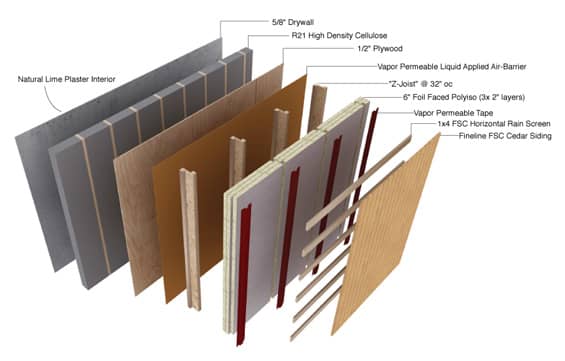
In addition to a suite of presentations by our North American PH compatriots, the conference will feature these keynotes:
Sean Penrith, Executive Director of the Portland-based Climate Trust – “Passive Building, Carbon and Climate”
Sebastian Moreno-Vacca, President of the Plateforme Maison Passive – “Belgium Adopts Passive House”
Joe Lstiburek, Principal of the Building Science Corporation – “Ventilation Standards and Passive Building”
Katrin Klingenberg, Co-Founder of the Passive House Institute US – “Climate & Culture Passive Standards: Moving Forward”
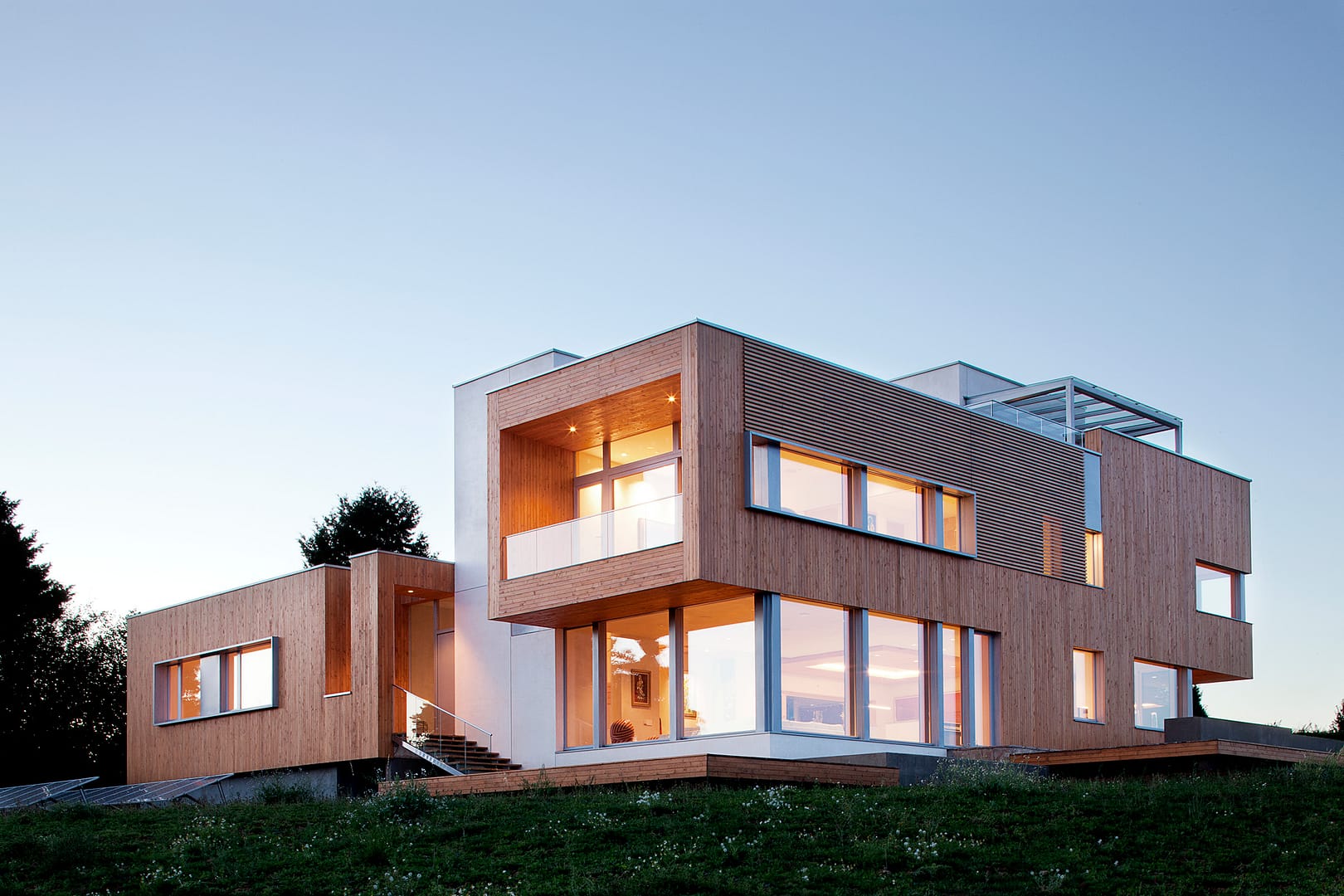
Karuna Passive House
For more info about the proceedings, visit the conference website.
– Zack
Original Title: New home, the Karuna House, featured in photos by Jeremy Bittermann Photography
Original Author: Molly Donegan
Originally Posted on: October 16th, 2013
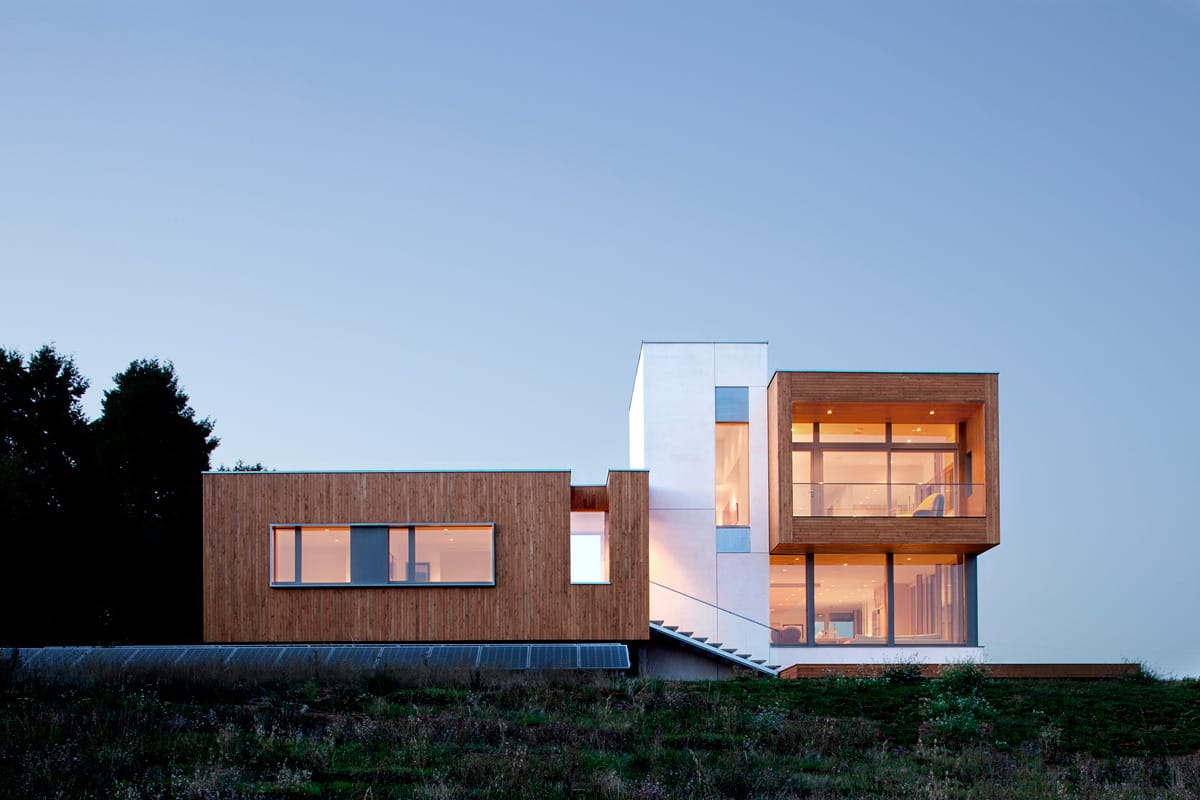
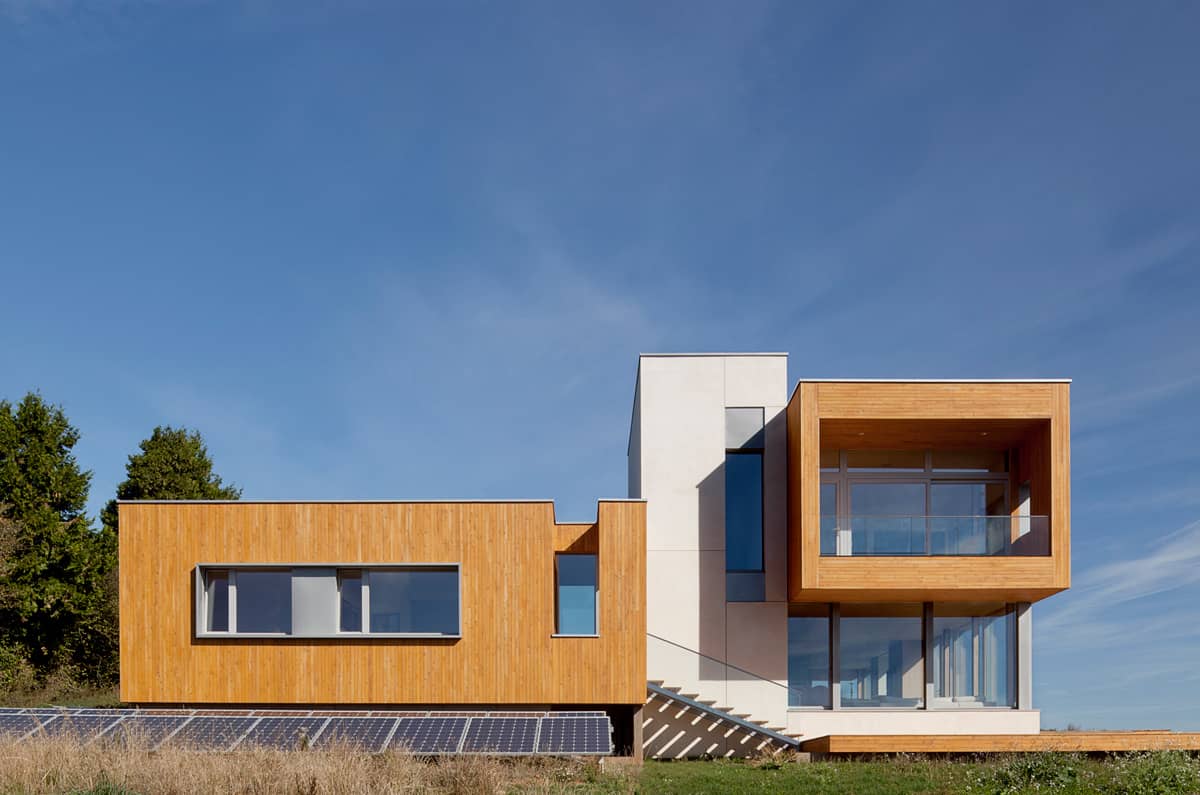
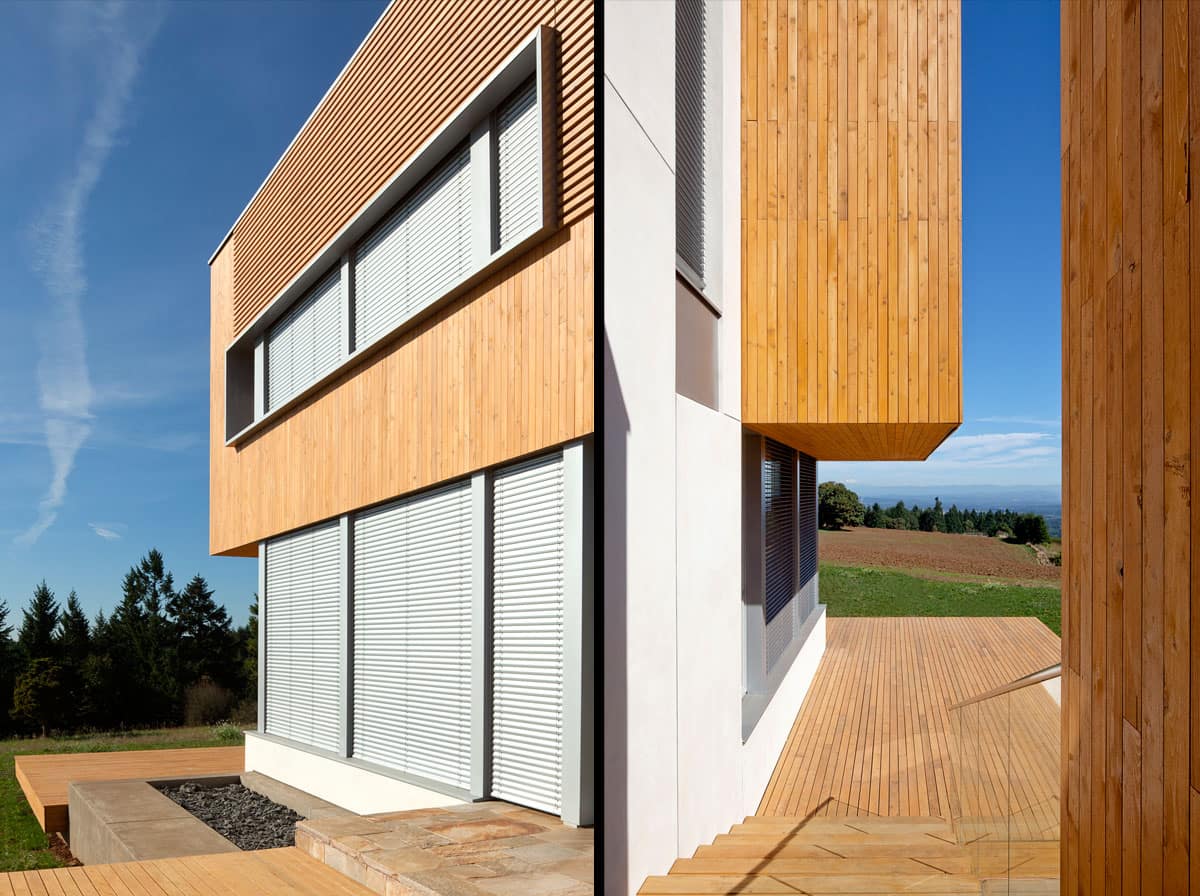
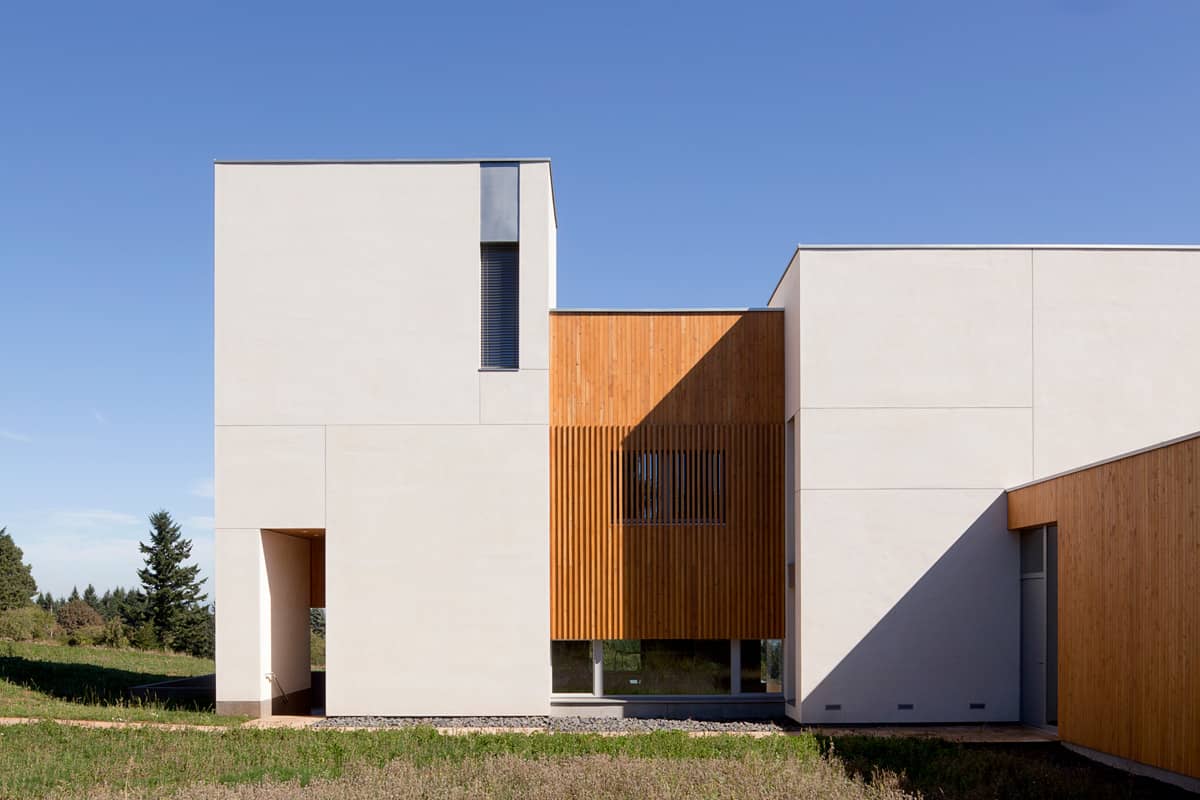
Photos of new über-efficient home in Newberg, OR show that high performance building and high design can go hand in hand.
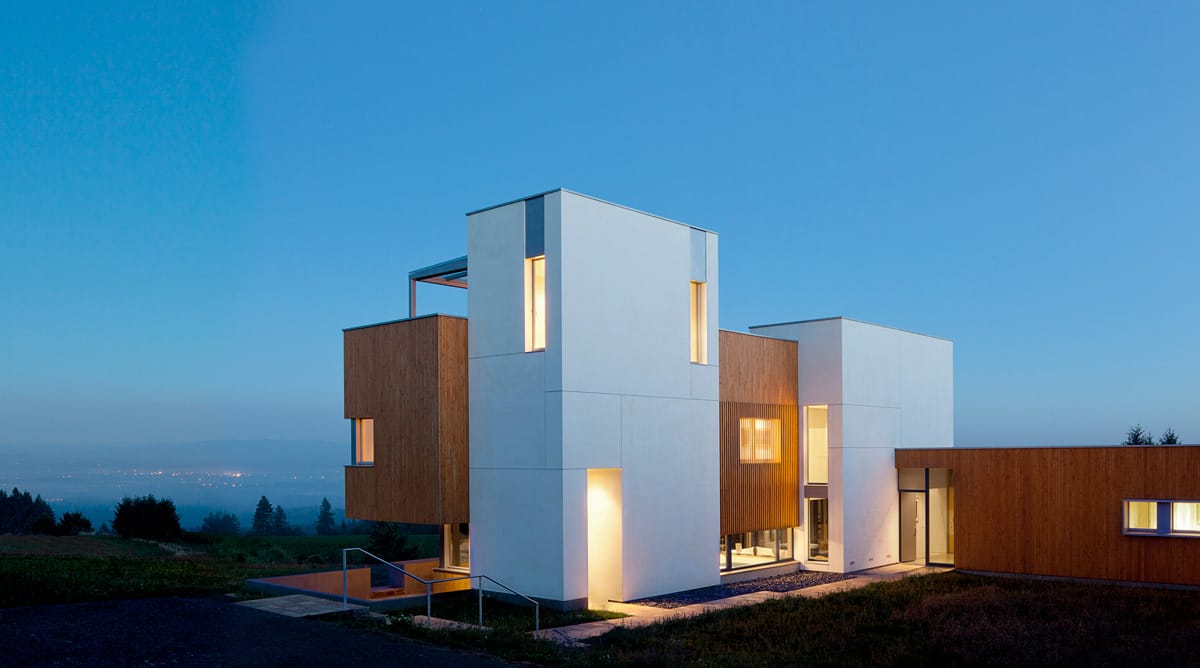
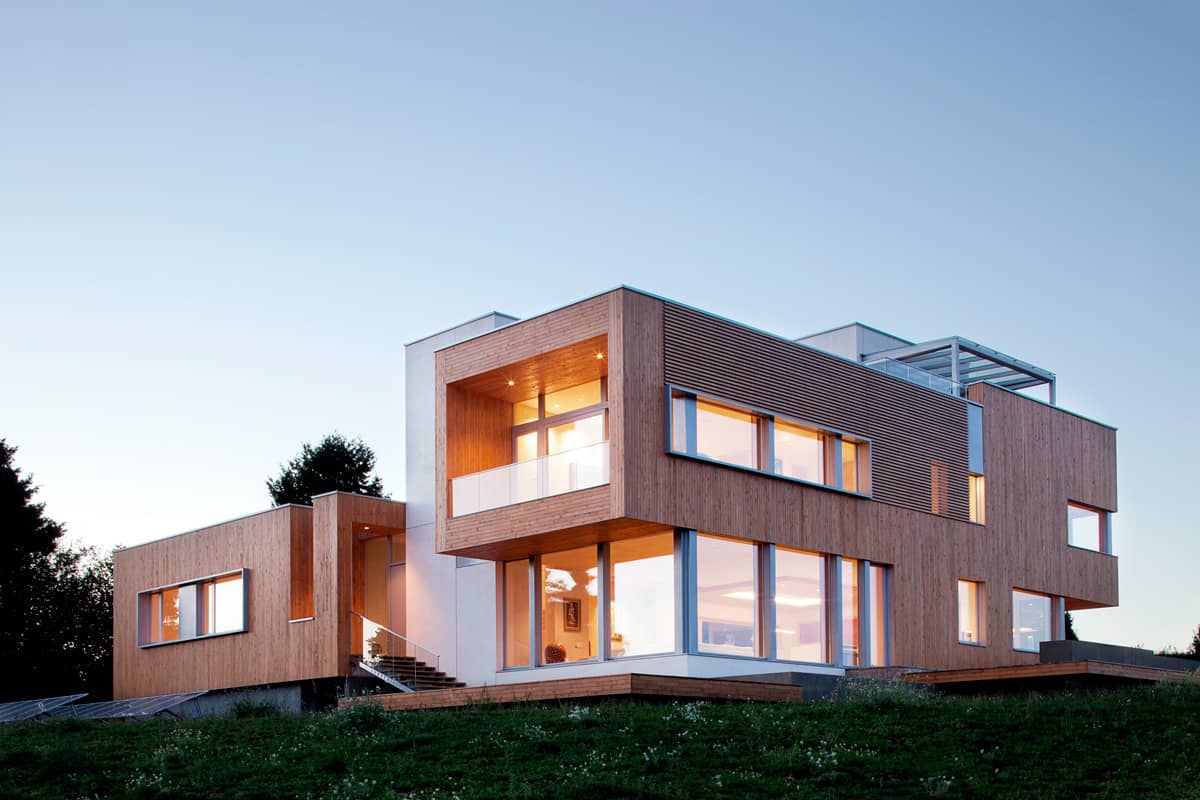
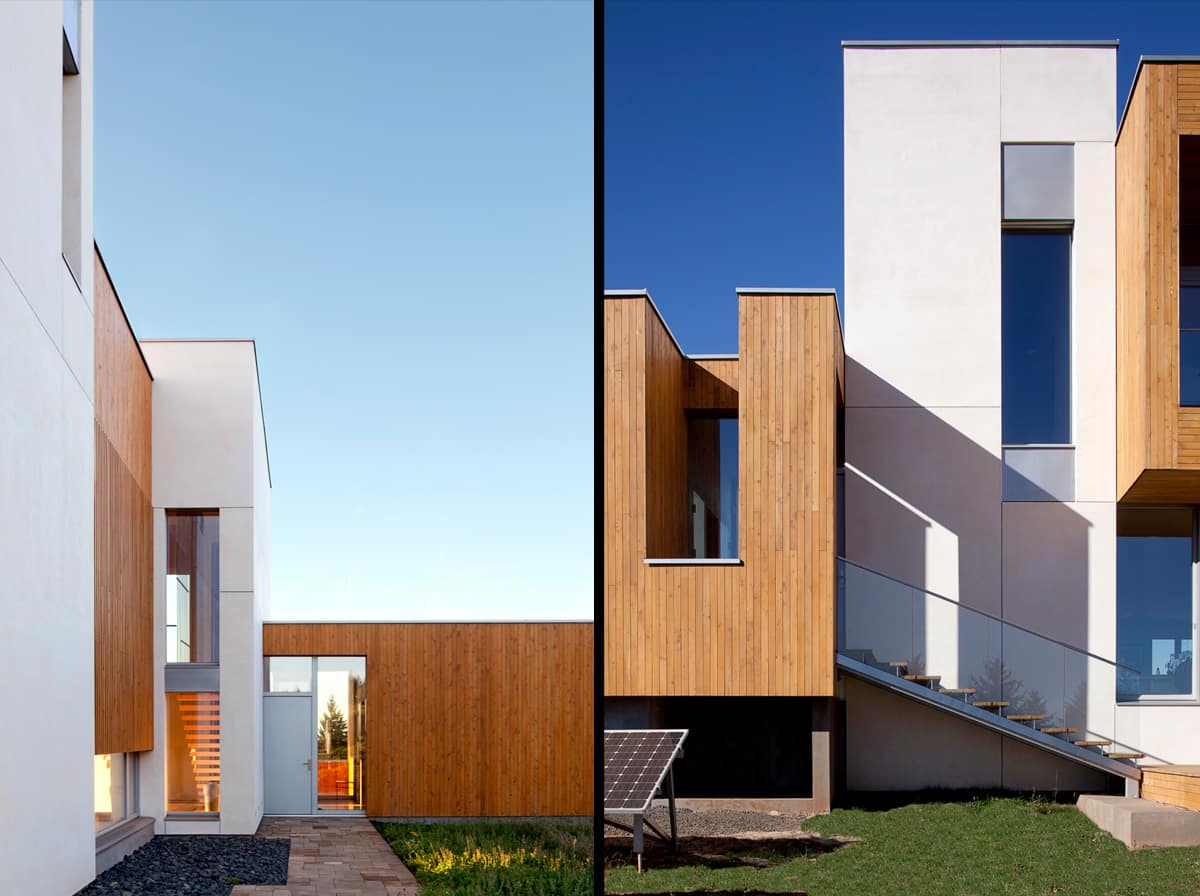
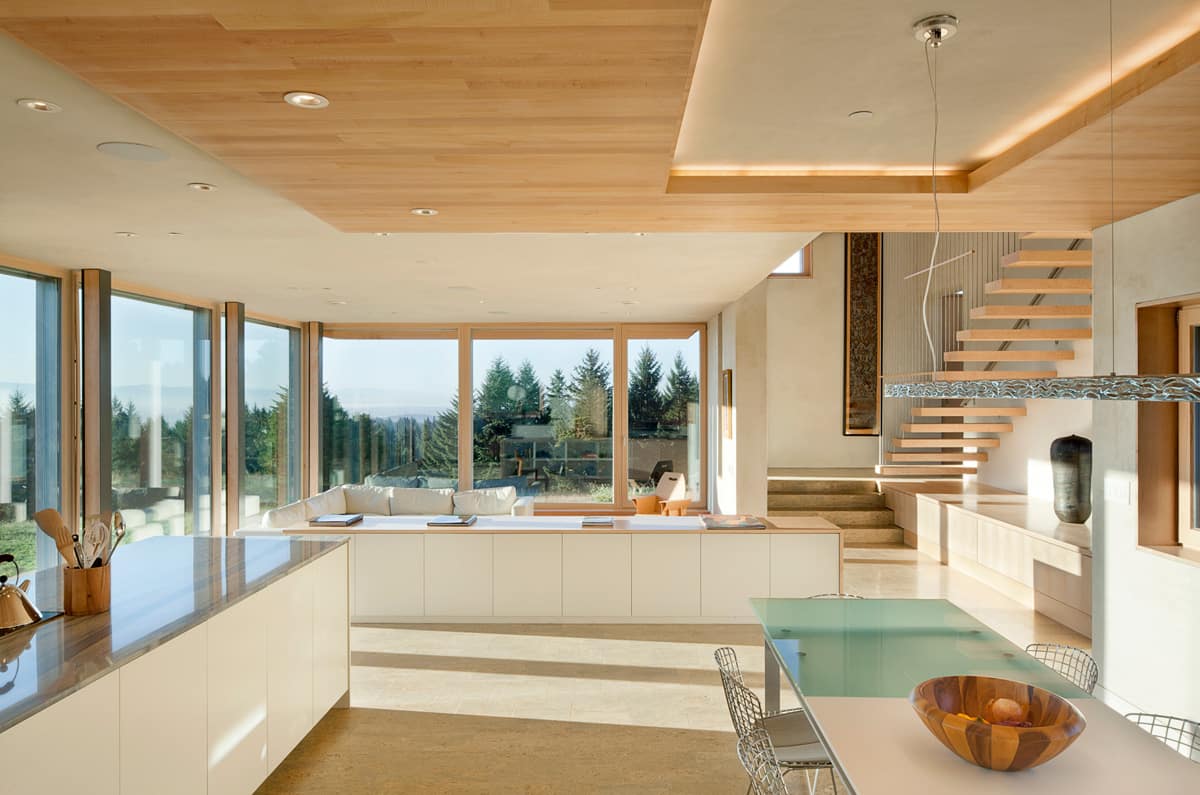
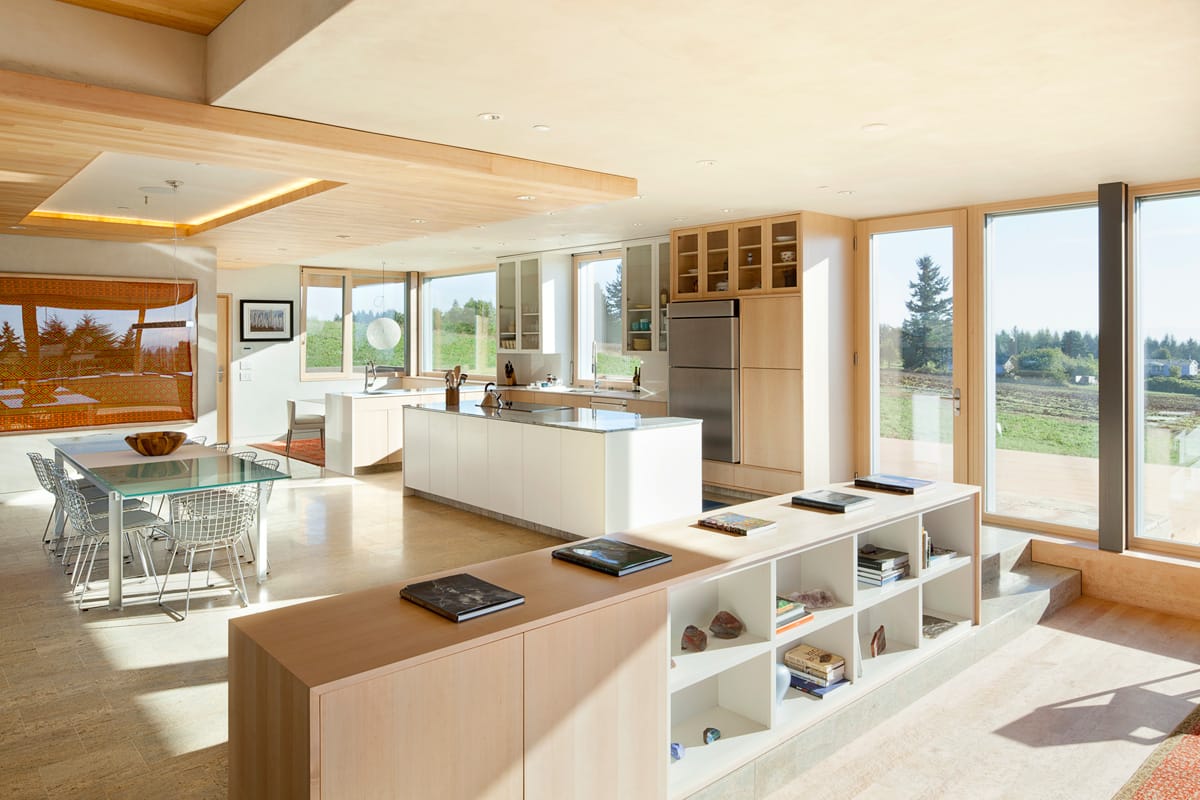
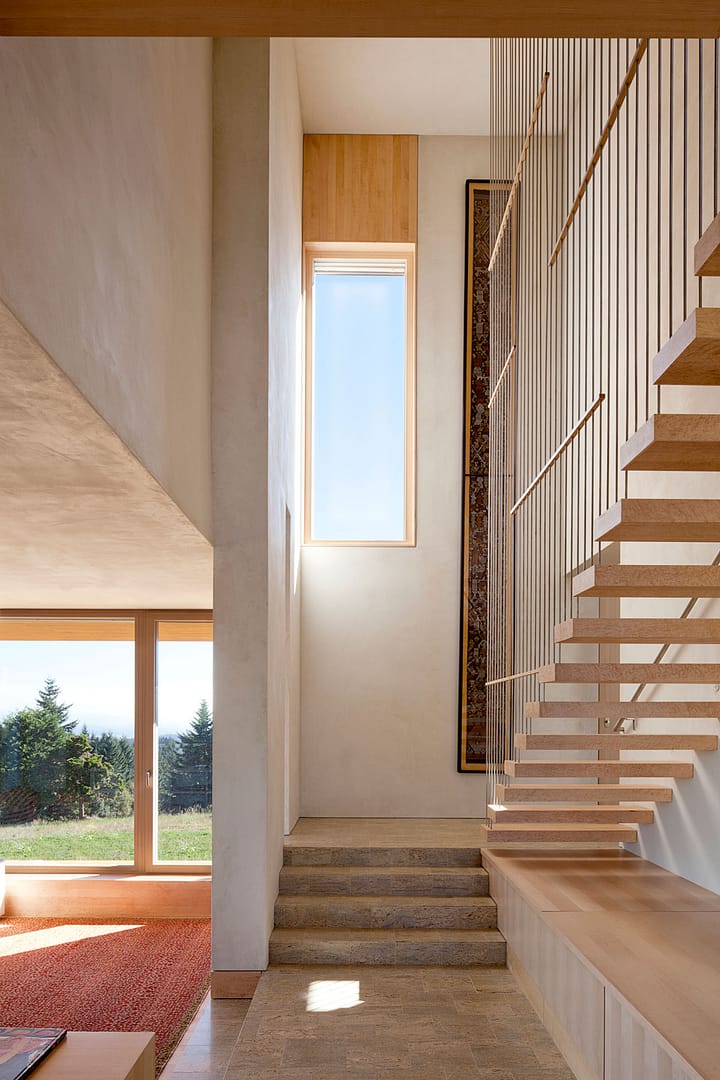
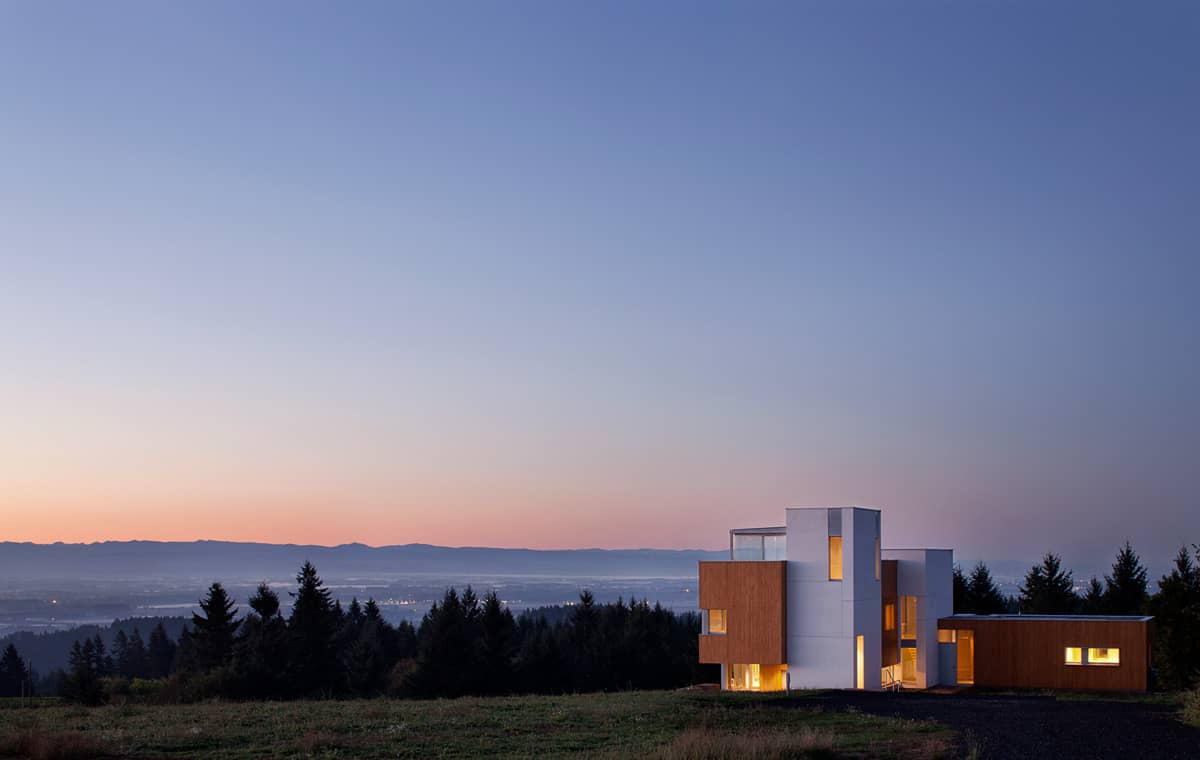
We’re happy to share these new beautiful photos of the Karuna House, a high performance new home designed by Holst Architecture and built by Hammer & Hand. Enjoy!
– Zack (Connect with me at +ZacharySemke)
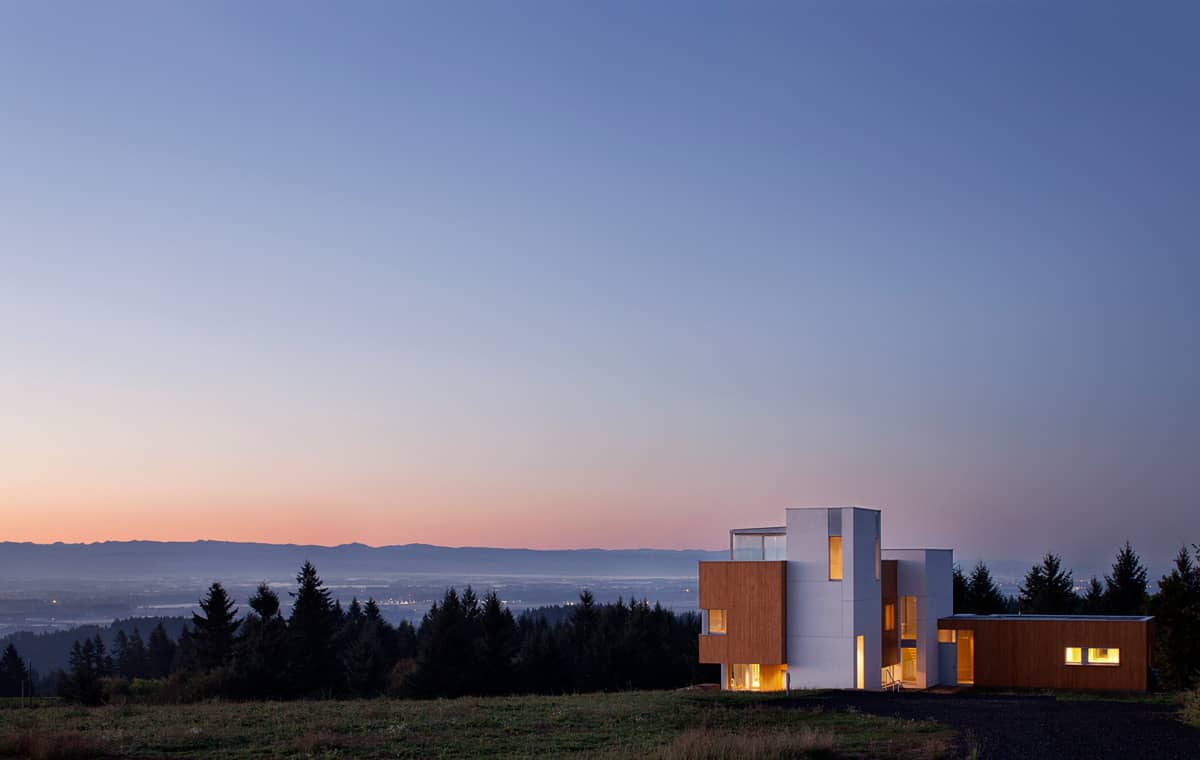
Photos by Jeremy Bittermann Photography
Original Title: Holst Architecture Wins 2030 Challenge Award at AIA Portland’s 2013 Design Awards for the Karuna House
Original Author: Molly Donegan
Originally Posted on: October 30th, 2013
Holst Architecture wins award of excellence for Karuna House from AIA Portland’s 2013 Design Awards.
Congratulations to Holst Architecture for winning an award of excellence from AIA Portland at its 2013 Design Awards! Projects were selected by a prestigious jury composed of Kai-Uwe Bergmann, principal of BIG in New York and Denmark; Lisa Chun, principal and co-founder of zeroplus in Seattle, WA; and Yo-ichiro Hakomori, founding partner and principal of wHY Design.
Holst Architecture received the 2030 Challenge Design Award of excellence for residential net-zero project Karuna Passive House. The 2030 Challenge calls for all new building and major renovations today to “be designed to meet a fossil fuel, GHG-emitting, energy consumption performance standard of 60% below the regional (or country) average for that building type.” This goal will move to 70% in 2015, 80% in 2020, 90% in 2025, and to carbon neutral in 2030.
The high performance Karuna house, built by Hammer & Hand, is the first in the world to earn Passive House, Minergie-P-ECO, and LEED for Homes Platinum (pending) certifications.
Read more about the Karuna Passive House here.
Original Title: “Triple crown” in green building is made official as Karuna House earns LEED for Homes Platinum certification
Original Author: Molly Donegan
Originally Posted on: December 3rd, 2013
New home now certified PHIUS+ Passive House, Minergie-P-ECO, and LEED for Homes Platinum.
It’s official! Karuna House is the first green building in the world to earn Passive House (PHIUS+), Minergie-P-ECO, and LEED for Homes Platinum certifications.
Photo by Jeremy Bittermann Photography
Holst Architecture and Hammer & Hand learned last week from the project’s LEED consultant, Earth Advantage Institute, that Karuna House earned a whopping 101.5 points in the LEED scoring system, easily surpassing the 80 point threshold required for Platinum certification.
The news means that the project team achieved its goal: to tackle three of the world’s most demanding green building certifications in one project, all while building a great house. The project became a case study of green building certifications and technique. To read more about our lessons learned, see this Field Notes post.
Congratulations to everyone involved. PHIUS+ Passive House, Minergie-P-ECO (first US project to be certified), LEED for Homes Platinum, and a beautiful house to boot…no small feat!
– Zack (Connect with me at +ZacharySemke)
UPDATE: EarthTechling picked up the story, read here.
Original Title: LEED can learn: green lessons from Karuna Passive House
Original Author: Molly Donegan
Originally Posted on: January 17th, 2014
Passive House modeling tools can eliminate a key LEED blind spot.
The Passive House building standard wears blinders. Its sole laser-like focus is on building energy performance and durability.
So most Passive House practitioners recognize that broader sustainable construction approaches like LEED, are naturally complementary. Passive House brings depth, promising revolutionary reductions in the carbon footprint of our built environment. LEED brings breadth, addressing environmental concerns like toxicity, renewable materials, water conservation, stormwater management, waste reduction, access to alternative transportation and much more.
To truly build “green,” we understand that we need both depth and breadth.
The Karuna House, a project pursued by the client as a case study of green building and green building certifications, certainly bore this out. (Karuna is the first building in the world to achieve the trifecta of LEED, Passive House and Minergie-P-ECO certification.) The broad green mandates of both LEED and the “ECO” portion of the Swiss certification Minergie-P-ECO ensured that the Karuna project team look well beyond energy performance in its definition of sustainable construction.
But the Karuna House also proved how powerful Passive House’s advanced understanding of building performance can be for LEED practitioners and their projects. Because just as Passive House is “blind” to broader sustainability issues, LEED has its own blind spot: it can’t see thermal bridges, at least not without help. Thermal bridges are elements of a building (steel beams, building junctions, window-wall interfaces, etc.) that allow heat energy to escape across the building envelope. And while they may sound wonkish and technical, thermal bridges demand respect: they are anathema to high performance building, providing an escape route for heat (or cool) to circumvent super-insulated assemblies and for moisture to penetrate walls and wreak moldy havoc. Check out this Engineering.com video, “2 R’s Won’t Make Your U”:
In low-load building, where efficiencies are high and tolerances are low, thermal bridges have an outsized impact on both building performance and durability. Seemingly minor elements, like a steel plate, can put a real drag on the performance. J. D’aloisio, author of the “Structural Engineer’s Pledge to Improve Building Envelopes,” says this in his article “My Journey to the Thermal Bridge”:
“… steel conducts heat about 1200 times better than expanded polystyrene (EPS) rigid insulation. This means that if the EPS insulation in an exterior building wall is “bridged” by a steel plate across an area which comprises just one tenth of one percent of the wall’s total area, more heat can flow through the steel plate than the entire rest of the wall!”
At the Karuna House we discovered some bad news for LEED practitioners: the tools for determining building energy performance for LEED projects – the HERS Index as modeled by REM/Rate for residential projects, and eQUEST for commercial projects – generally ignore thermal bridges. The closest that REM/Rate comes to recognizing thermal bridges is to account for the energy loss transmitted through framing. In theory, your building’s envelope could be riddled with thermal bridges both obvious (steel beams protruding through walls) and obscure (poorly detailed foundation-to-wall transitions) and perform just as well in LEED’s eyes as a thermal bridge-free building. The reality, of course, would be much different, full of disappointing surprises for one (wasteful energy performance, mold, and building durability problems) and high performance contentment for the other. We could have built a Karuna House full of thermal bridges and it still could have achieved LEED Platinum status. But it would have failed Passive House and Minergie-P certifications miserably.
THERM Analysis of Thermal Bridge-Free Wall at Karuna House
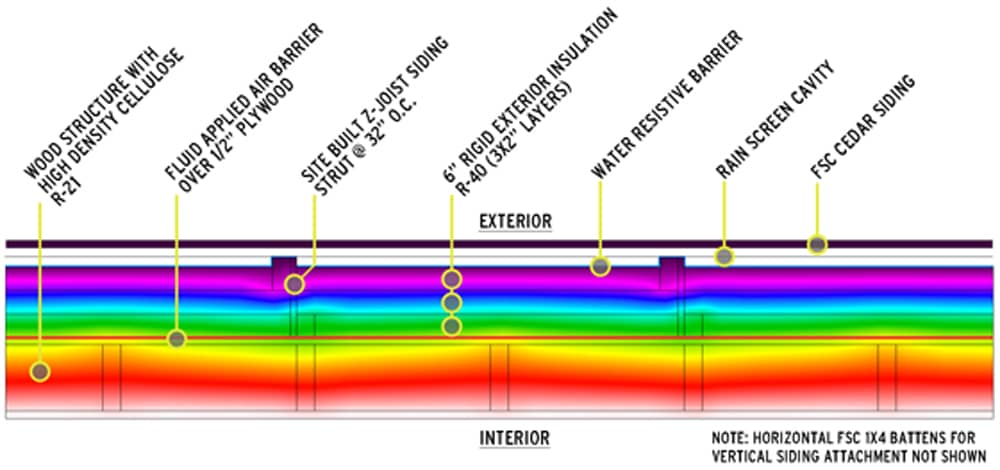
Chicago’s Aqua Tower (certified LEED-NC) is a beautiful, high design example of LEED’s disconnect around thermal bridging. Joseph Lstiburek of Building Science Corporation writes in his article about the project, “Thermal Bridges Redux”:
“It is a beautiful building. Quite stunning actually. It is an embodiment of everything that is right and wrong with architecture. An orgy of glass and concrete. It is a thermodynamic obscenity while it takes your breath away. An 82-story heat exchanger in the heart of Chicago.”
Check out the article for some stunning infrared photography of the building, as well as his prescriptions.
The good news for LEED practitioners (and therefore for the rest of us, given what a force LEED is in the green building world) is that modeling tools borrowed from Passive House like the Passive House Planning Package (PHPP) and WUFI-Passive understand and address thermal bridges and can be plugged into the LEED process in a straightforward way. There’s a clear pathway – one that we used at Karuna – for LEED project teams to understand, quantify, and reduce thermal bridging, and therefore deliver on promised building performance.
Thanks to work done by Passive House Institute US and RESNET in creating the PHIUS+ certification, the U-value assembly data from PHPP that includes robust analysis of potential thermal bridges can now be entered into the backend of REM/Rate, allowing the software to incorporate vital thermal bridging data into the HERS Index score of the building. LEED certifications based on these enhanced HERS Index scores are no longer blind to performance-sapping thermal bridges.
An added bonus of getting tools like PHPP and WUFI-Passive included in the design process for LEED projects is that they are optimization tools, not just verification tools like REM/Rate. PHPP and WUFI-Passive can be used to analyze hundreds of different design configurations to determine optimal balance of efficiency, cost, and other design goals. Especially in budget-conscious high performance building, this ability for “parametric analysis,” or simultaneous testing of many design parameters, is mission critical. And the power of PHPP and WUFI-Passive are available to LEED practitioners regardless of whether they choose to pursue Passive House levels of performance.
Because Karuna’s purpose is to provide lessons for green builders, I’ll close this post with a few findings from the project that we think are relevant to LEED professionals, Passive House designers and builders, and the green building community as a whole:
- Not only are the broad scope of LEED and the singular focus of Passive House complementary, a paired approach is actually vital in achieving a truly “green” project. The Swiss Minergie-P-ECO designation recognizes this, with its “P” roughly equivalent to Passive House and its “ECO” similar to LEED.
- Effective energy modeling is vitally important in the design process of high performance building and tools borrowed from Passive House, like the Passive House Planning Package (PHPP) and WUFI-Passive, can help LEED projects eliminate the thermal bridge blind spot.
- As code bodies reach for increasing levels of building energy efficiency, the success of future performance-based code will depend on the same comprehensive energy modeling borrowed from Passive House that LEED projects can benefit from.
- Our big, collective goal – averting catastrophic levels of climate change through meaningful reductions in building greenhouse gas emissions (as called for by the 2030 Challenge) – therefore depends on better modeling that takes things like thermal bridges into account. Fortunately those tools are readily available, and improving in accuracy and ease of use.
– Zack (Connect with me at +ZacharySemke)
Further reading:
“BSI-059: Slab Happy”
The Karuna House Foundation System
Pumpkin Ridge Foundation System
Original Title: H&H and Holst Architecture to present Karuna case study and tour this month
Original Author: Zack Semke
Originally Posted on: July 3rd, 2014
High performance meets high design at Karuna House, the first building to achieve three of the world’s most demanding energy efficiency certifications: LEED for Homes Platinum, Minergie-P-ECO, and Passive House.
Join Hammer & Hand and Holst Architecture for a Friday, July 25 class and Saturday, July 26 project tour, presented by AIA Portland, that dispel the myth that high performance building and high design don’t mix. Karuna House’s advanced building science and Passive House construction detailing resulted in both award-winning design and revolutionary energy performance. The home earned AIA Portland’s 2030 Design Award last year and has reached Net Positive energy use: onsite solar panels power the home and charge the owner’s Tesla.
Friday’s class will begin with a primer on the Passive House approach to super-efficient building, presented by Sam Hagerman, owner of H&H. Holst Architecture principal Jeffrey Stuhr and associate Cory Hawbecker will then share the design of Karuna House, its multiple green building certifications, and how the home’s high performance details dovetailed with the project’s programmatic and aesthetic goals.
Saturday’s tour will build on this class material and offer the rare opportunity to view the Karuna House, guided by the project team. Sam, Jeffrey, Cory, and H&H project supervisor Scott Gunter will review the project onsite, diving deep into inspirations, assemblies, and lessons learned.
Register for one or both of these events here.
We hope to see you there!
– Zack
Original Title: Karuna House, PDX FutureGreen, and the Tesla Effect
Original Author: Zack Semke
Originally Posted on: September 22nd, 2014
I recently joined Eric Lemelson, owner of Karuna House, to present about his project at Earth Advantage’s PDX FutureGreen event at the Jupiter Hotel. It was a fun evening, showing off slides of a beautiful project to a happy crowd at the Jupiter’s outdoor “Dream Tent” on a warm, late summer’s night. Two hundred or so realtors, appraisers, lenders, and green building industry folks were gathered for a keynote by Jules Bailey (Multnomah County Commissioner) and a panel discussion by sustainability experts about the future of sustainable development and housing in Portland.
Whenever we at H&H speak about Karuna we start with its fusion of high design and high performance building (an accomplishment recently recognized by an AIA Portland 2030 Challenge design award bestowed to Holst Architecture.) We next celebrate that it’s the first building in the world to achieve the green building triple crown of Passive House, LEED, and Minergie certifications. We explain that Passive House’s laser-like focus on energy performance is complemented by LEED’s wide focus on broader sustainability goals. We point out that the Minergie-P-Eco certification earned by Karuna is a Swiss version of this same complement, with the “P” standing for a close parallel of Passive House and the “Eco” representing a broad set of sustainability targets.
But for the audience at PDX FutureGreen – a group focused on the marketability and feasibility of sustainable homes – I wanted to emphasize how Karuna House dispels myths.
The first is the myth that super-insulated, airtight, mechanically ventilated buildings cut off occupants from nature – that they somehow interfere with the inside/outside connection. In fact, the reverse is true. To understand why, we need to consider what makes up the “inside/outside connection” in buildings: inside access to views to the outside, natural light, and fresh air.
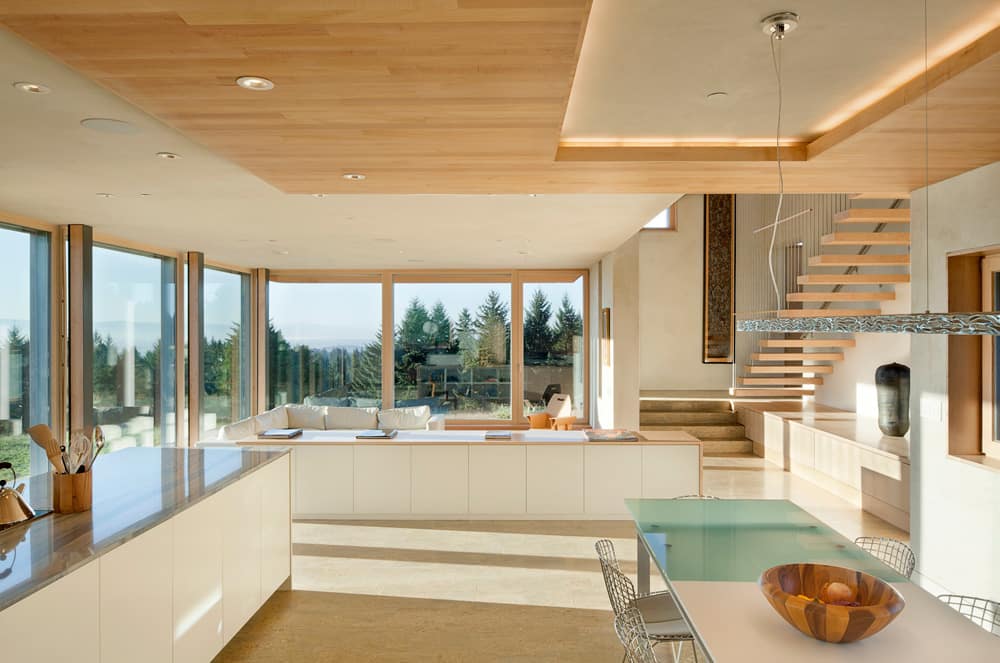
This photo of Karuna’s interior shows the flood of natural light coming into the space, as well as its sweeping views of the surrounding landscape. What the photo does not show is the quality of air inside; it feels like you’re outside breathing oxygen-rich fresh air (though filtered of allergens.) Thanks to the home’s toxic-free construction, the air is so pure that you notice subtle things like the fragrance of the natural wood trim inside. Of course, if you ever want a more immediate, direct portal to the outside you can always open a window – not a big deal. But when I’m at the house it never occurs to me to do so. I already feel connected to the outside. High performance buildings like Karuna have as strong an inside/outside connection as any buildings out there.
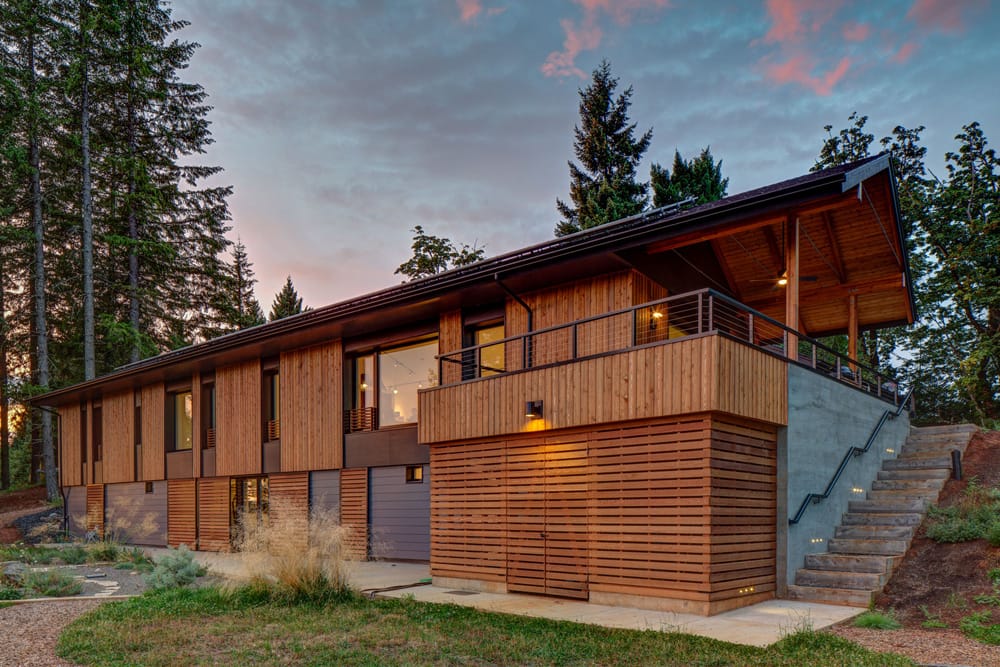
The second myth to dispel is that these “legacy buildings” – buildings that are part of the climate solution, that are so durable that they’ll last for generations, and that are so gracious to inhabit that people will care for them for generations – are limited to higher budget projects like Karuna. In reality, the building techniques and components that make Karuna House perform so well are not expensive. That’s why Reach CDC is able to build its Passive House affordable housing project at Orenco Station today. And it’s why we were able to deliver the Pumpkin Ridge Passive House, designed by Scott|Edwards Architecture, to a middle income family of four. The modest added expense of bringing the home to Passive House levels of efficiency, durability, comfort, and air quality will be offset by ongoing utility bill savings.
Our colleagues at Earth Advantage call it the Tesla Effect: with time, experience, and scale what starts as out-of-reach can become accessible to a broad market. The base version of Tesla’s popular Model S costs $70,000 today, but next year’s Model III will retail for just $35,000. So too with high performance building: while some prominent examples are pricey, high performance homes are in fact accessible to most of the market right now.
So let’s make high performance building the “new normal” today.
(Visit our High Performance Building page to learn more about H&H’s approach, including project examples, video, and articles.
Original Title: National Institute of Building Sciences bestows prestigious Beyond Green Award on Karuna House
Original Author: Zack Semke
Originally Posted on: January 8th, 2015
At an awards ceremony this afternoon at the National Institute of Building Sciences’ conference in Washington, DC, Hammer & Hand’s Sam Hagerman accepted a Beyond GreenTM Merit Award on behalf of the Karuna House and its project team.
One of just four Beyond Green Awards granted by the Institute and its Sustainable Building Industry Council this year, Karuna House’s award recognizes the home’s role as a national exemplar of high performance green building. Designed by Holst Architecture and built by Hammer & Hand, Karuna House is the first in the world to achieve the green building triple crown of Passive House, LEED, and Minergie certifications.
“Their [the Karuna House Project Team] pursuit of three different certifications is commendable and can provide valuable lessons for the industry,” said Beyond Green jurist RK Stewart, FAIA. “Achievement of these certifications points to the importance of integrated processes and whole building design.”
To read the Institute’s full announcement of the 2014 Beyond Green Award winners, visit http://www.nibs.org/news/209829/SBIC-Recognizes-2014-Beyond-Green-Award-Winners.htm. (The top Honor Award was awarded to the Bullitt Center, the Living Building Challenge office building which serves, incidentally, as home to Hammer & Hand’s Seattle office.)
“The owner of Karuna House created the project as a case study for what can be accomplished in high performance green building,” said Hagerman after accepting the award. “So it’s gratifying to see the project receive this recognition. It’s an honor to be part of the team.”
NIBS-Sam
Above: Sam accepts award from Henry L. Green, President, National Institute of Building Sciences. Photo by Jocelyn Augustino, courtesy of the National Institute of Building Sciences
For more about Karuna House, including project photos, videos, and articles, visit https://hammerandhand.com/portfolio/karuna-house/
Original Title: Karuna House wall assembly, illustrated: first of four analyses of high performance walls
Original Author: Zack Semke
Originally Posted on: August 21st, 2015
Our “Evolution of Enclosure” exhibit at AIA Portland (open through September 10) examines the role that buildings – especially building enclosures – can play in helping to diffuse climate change. As examples, the exhibit draws on four projects built by Hammer & Hand: Karuna House designed by Holst Architecture; Pumpkin Ridge Passive House and Glasswood Commercial Retrofit, both designed by Scott | Edwards Architecture; and Madrona Passsive House designed by SHED Architecture & Design.
The exhibit itself includes a set of four beautiful full scale cross sections, built by Hammer & Hand’s Jason Woods, of the high performance wall assemblies for these four projects to achieve the Passive House performance. Drop by AIA Portland to check them out!
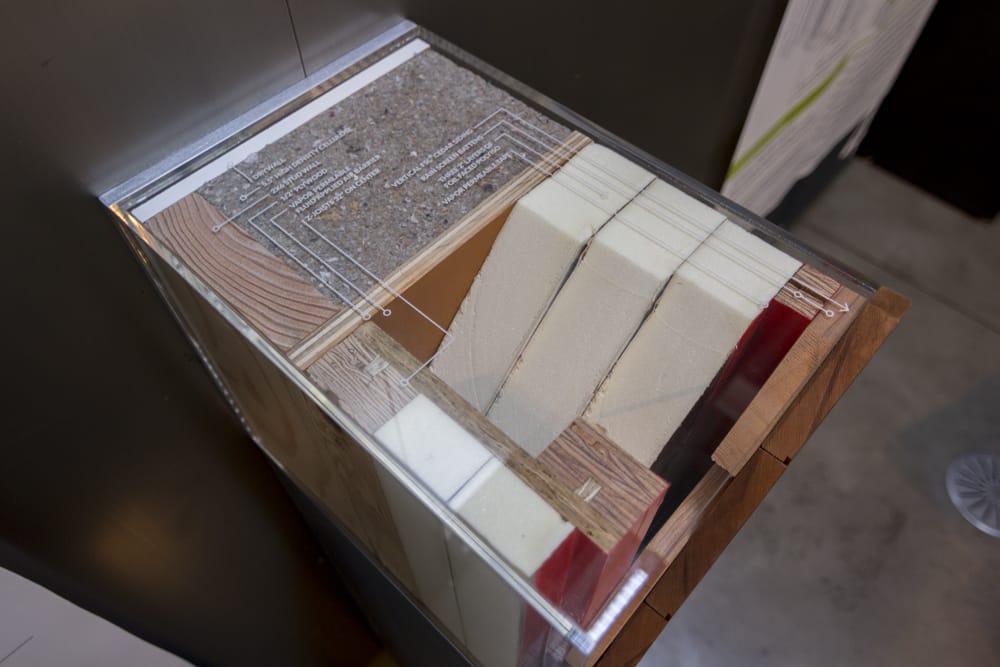
Each of these wall cross sections is accompanied by a series of illustrations, created for us by Ryan Sullivan of Paste in Place, explaining how each manages for heat, air, and moisture. In a series of four posts we plan to share these illustrations and the analysis embedded within in them. This week, Karuna House!
Karuna House
At Karuna House, the client and designers determined the form of the building first and the strategy to bring that design to high performance levels was overlayed second. So the wall assembly had to be especially thermally resistant to allow for the form’s articulations and increased surface area. The key challenge was to do this while not making the wall extremely thick.
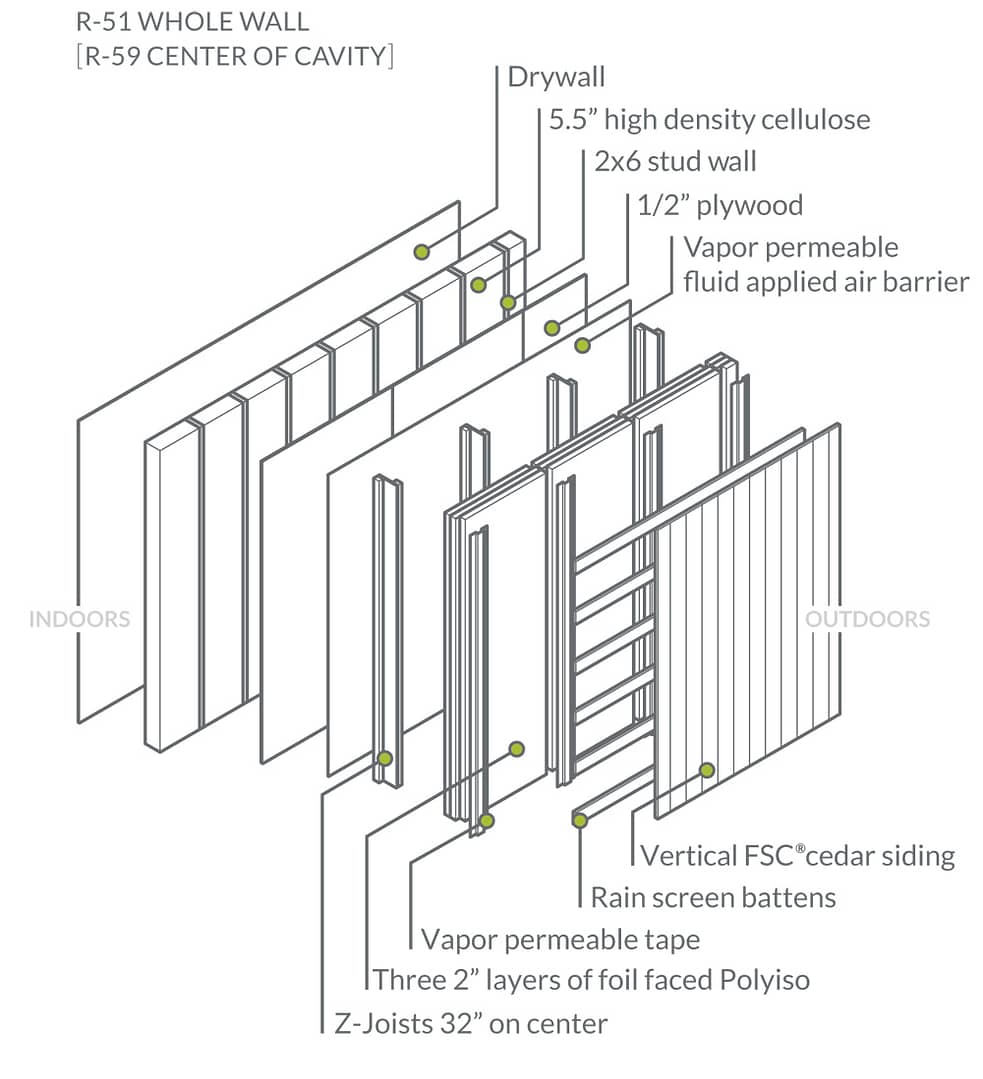
The air barrier for the Karuna House wall assembly is a fluid applied, vapor-open membrane manufactured by Prosocco.
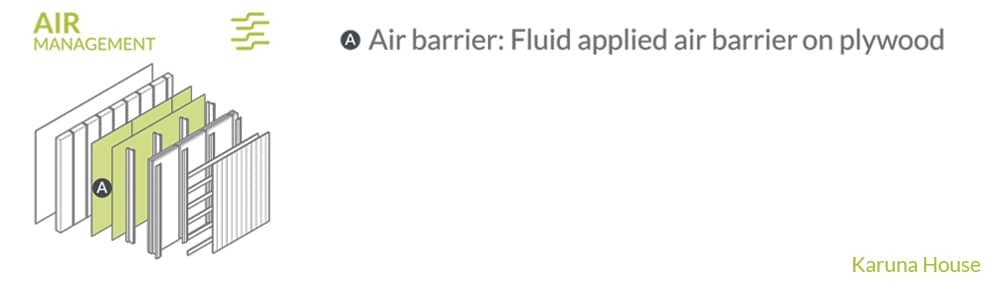
The assembly’s high R-59 insulative value (center of cavity, including gypsum, plywood, and air films) is provided by a 5.5” layer of high density cellulose (R-21) and three 2” layers of foil faced polyisocyanurate insulation (R-36) with seams offset by the z-girts that hold the layers in place.
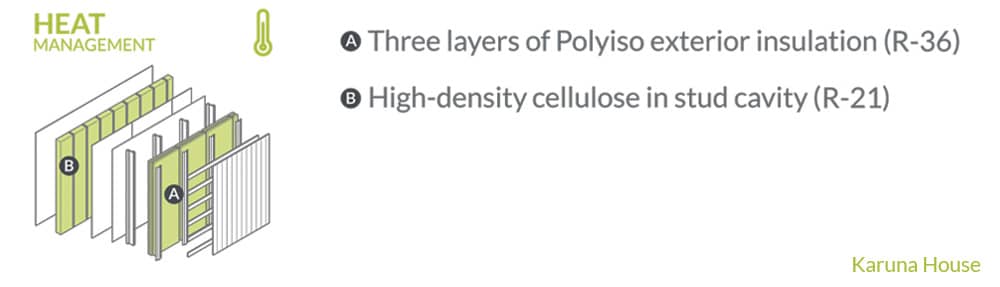
The first line of defense for bulk water management is Karuna House’s siding and the ventilated rainscreen cavity behind that siding that allows water to drain harmlessly away. The second barrier is the foil face of the Polyiso insulation. And if any water were to penetrate beyond that, the final barrier is the fluid applied, vapor-open air barrier mentioned above.
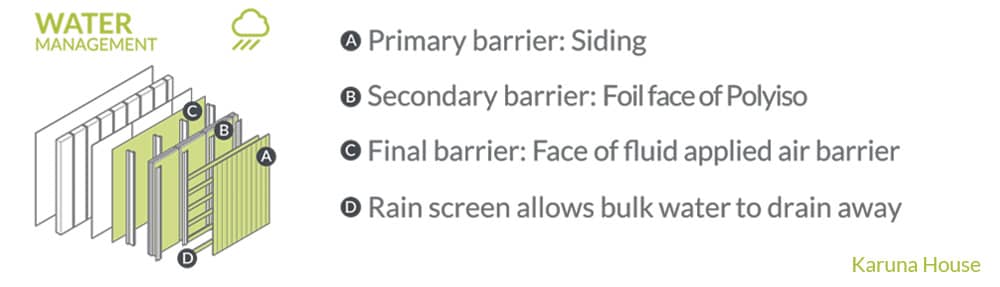
Starting just inboard of the innermost layer of foil faced Polyiso (the foil is a vapor barrier), the assembly is vapor open to the inside, but not the outside.
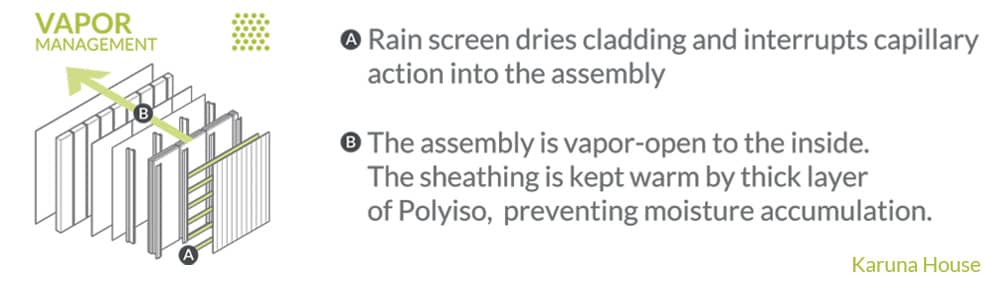
This strategy works because the Polyiso keeps the structural sheathing so warm and protected, as shown in this THERM diagram. Any water that finds it way between the Polyiso and the fluid-applied air barrier gets warm, becomes vapor, and then transfers harmlessly inside through the vapor-open side of the assembly.
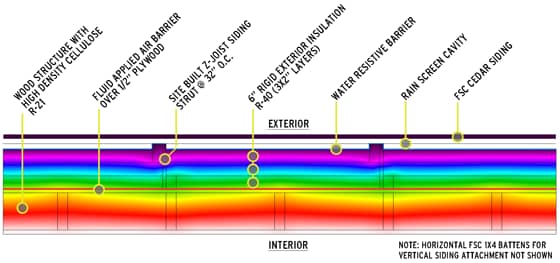
See an annotated photo tour of the assembly’s layers:
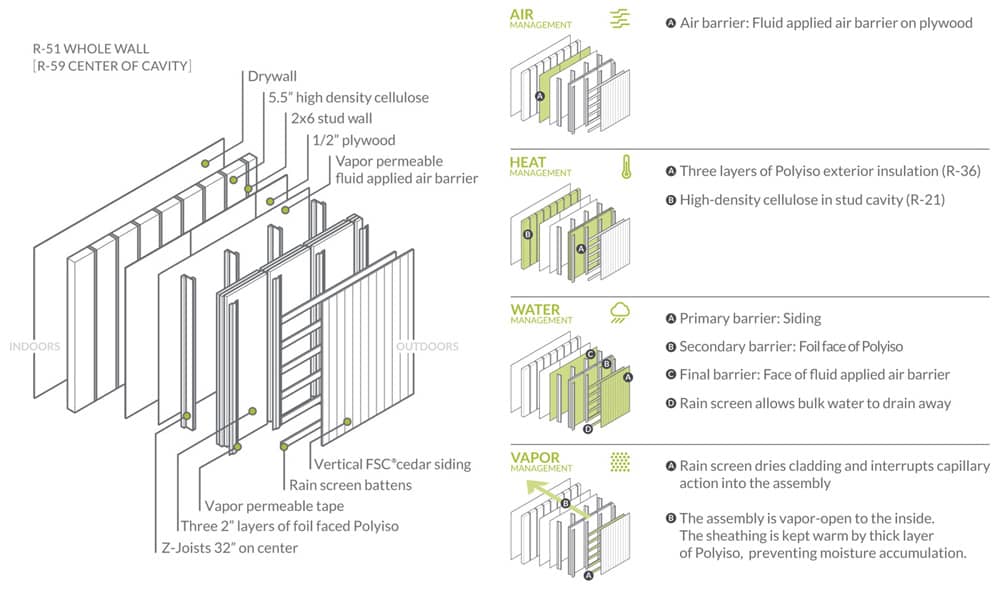
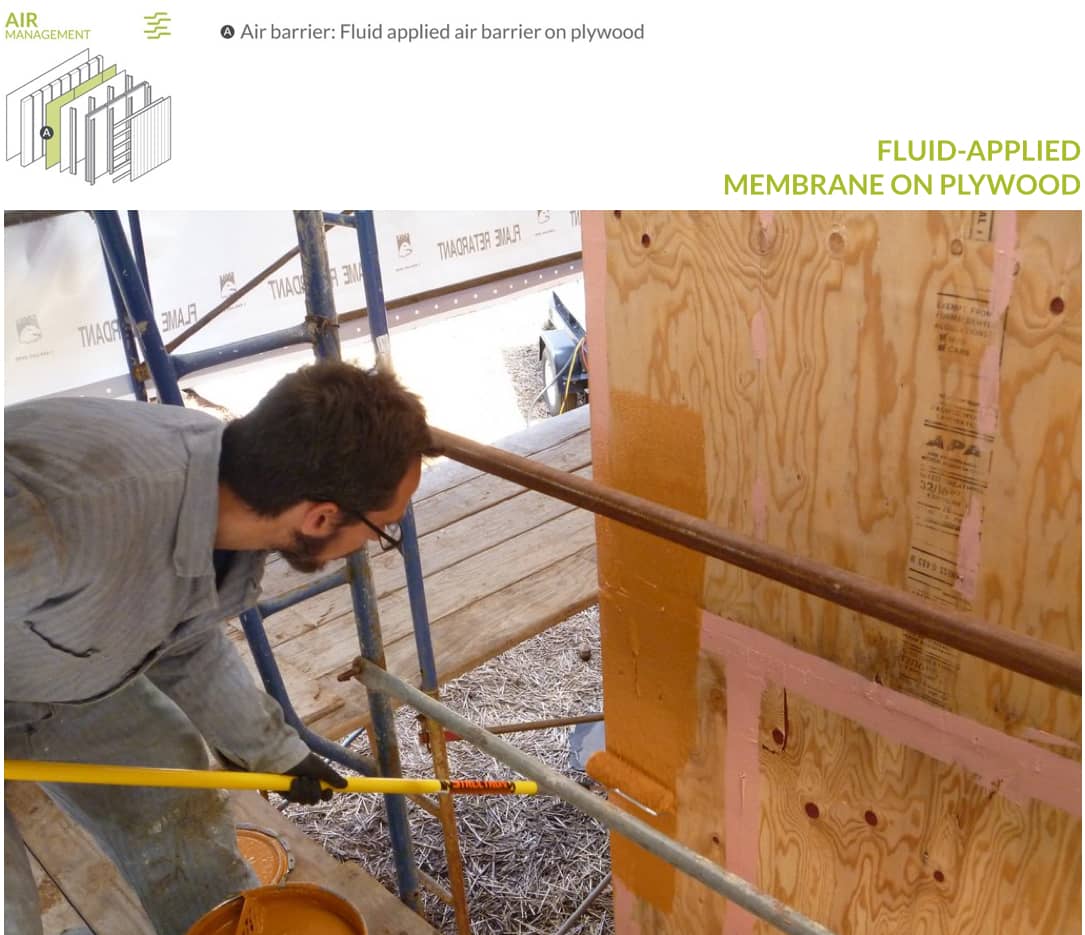
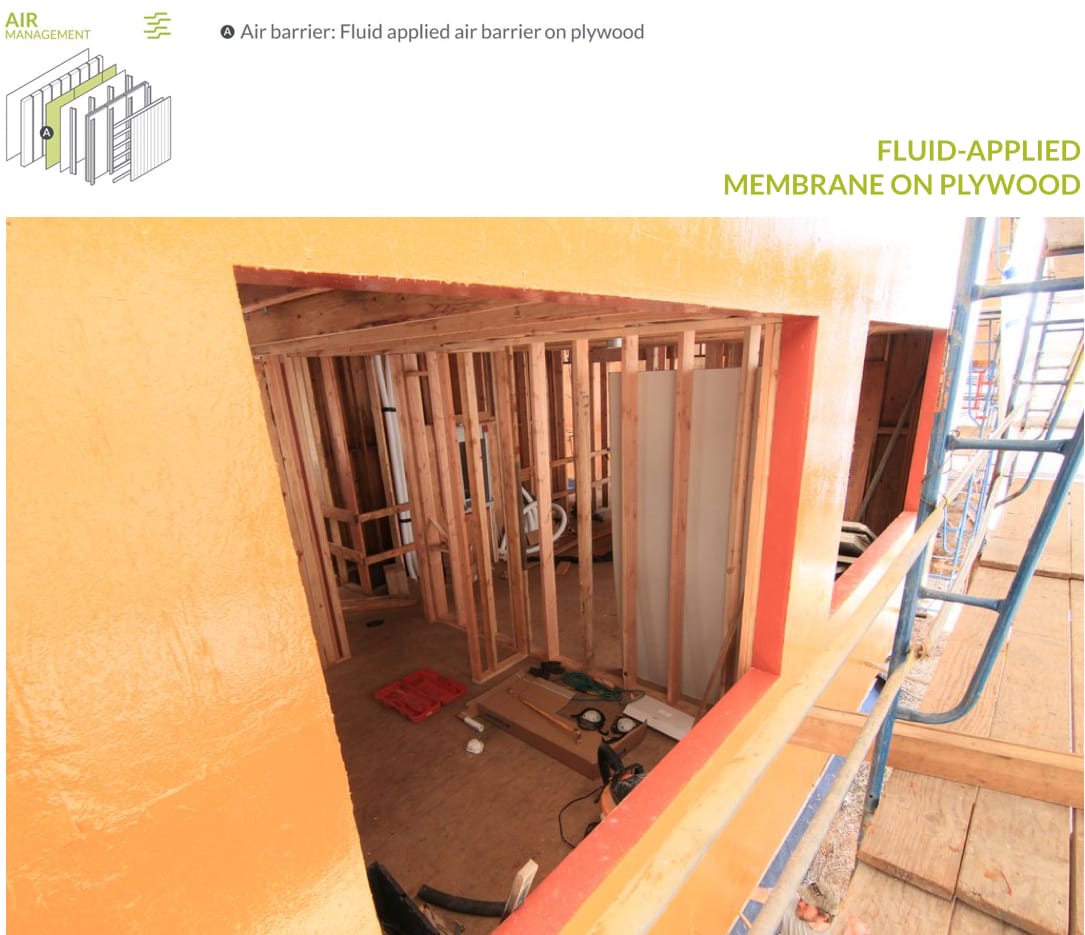
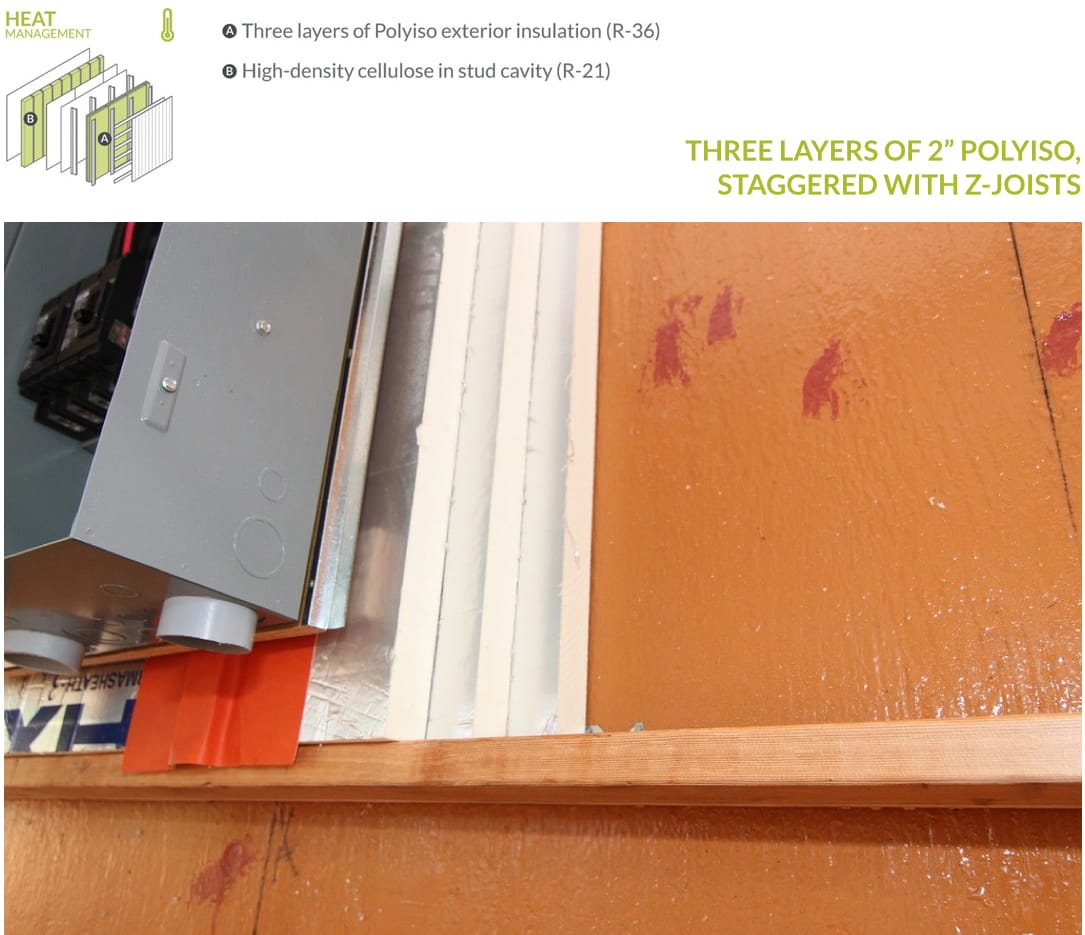
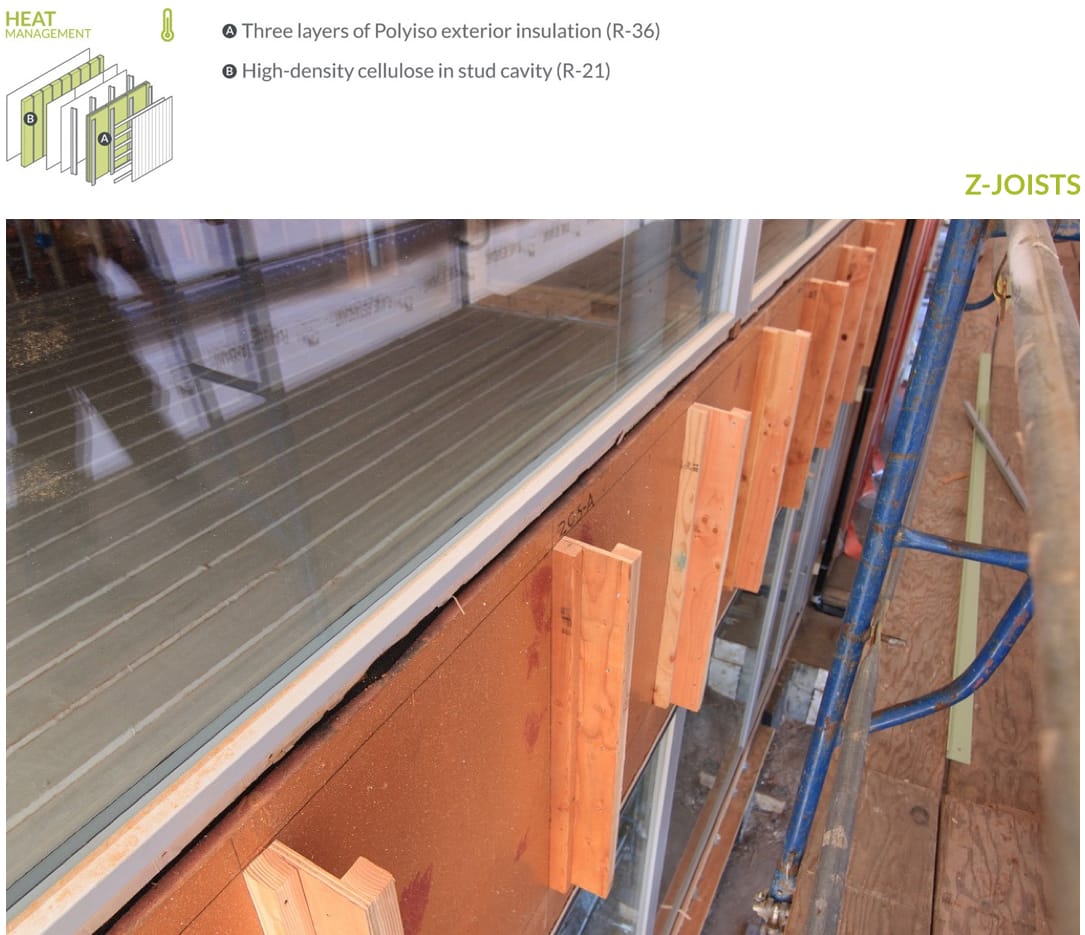
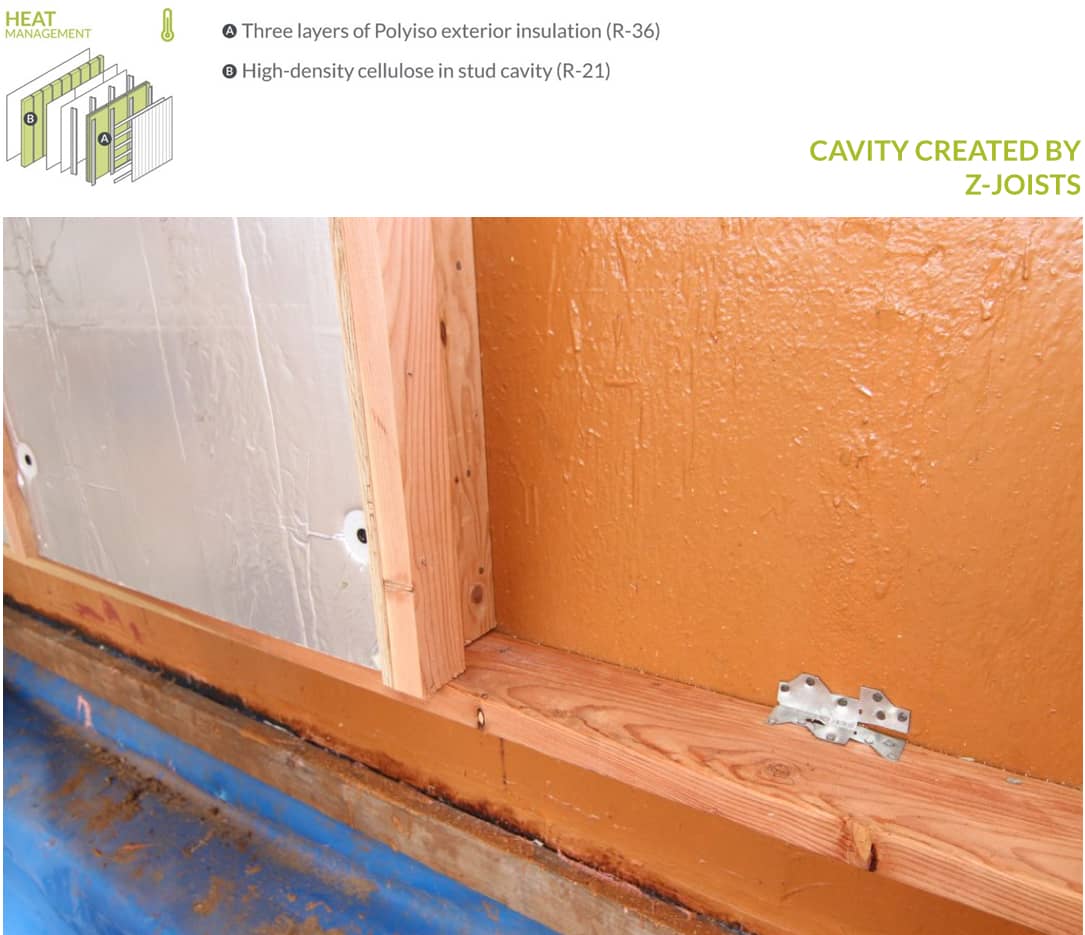
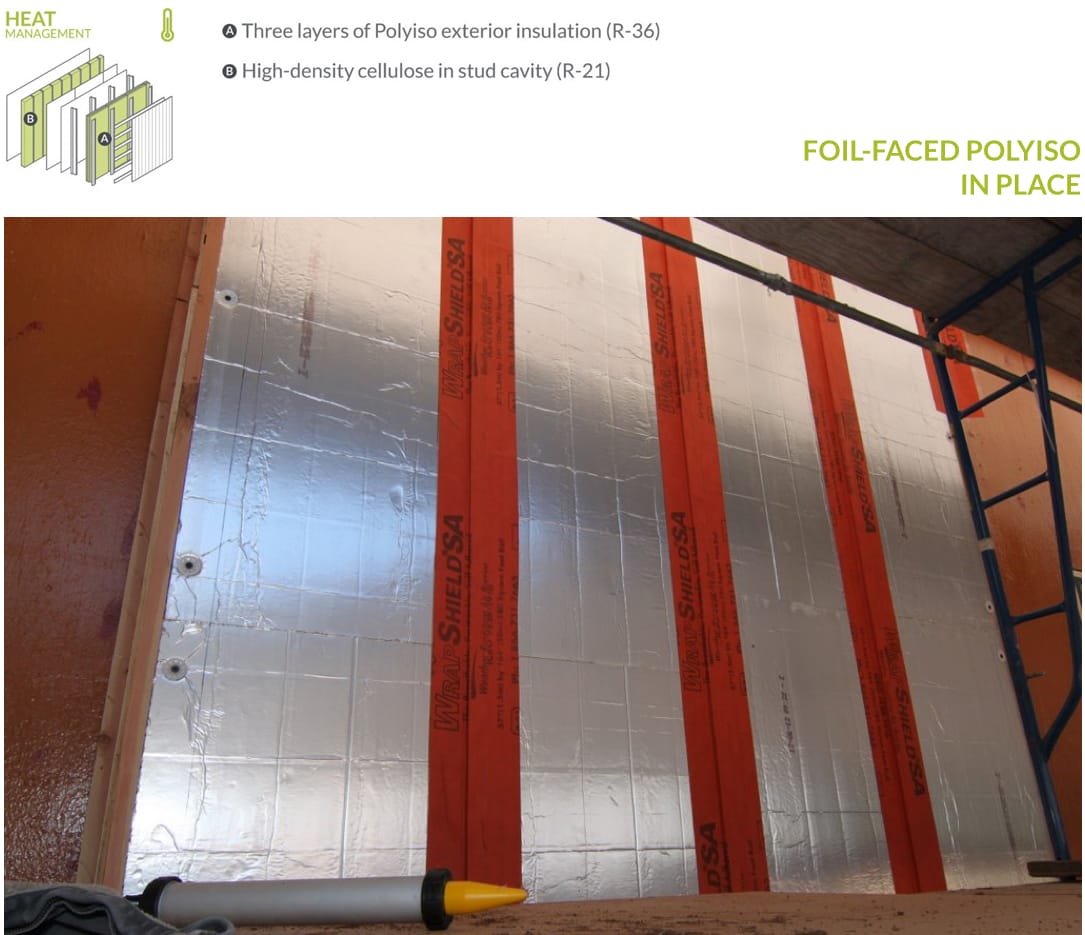
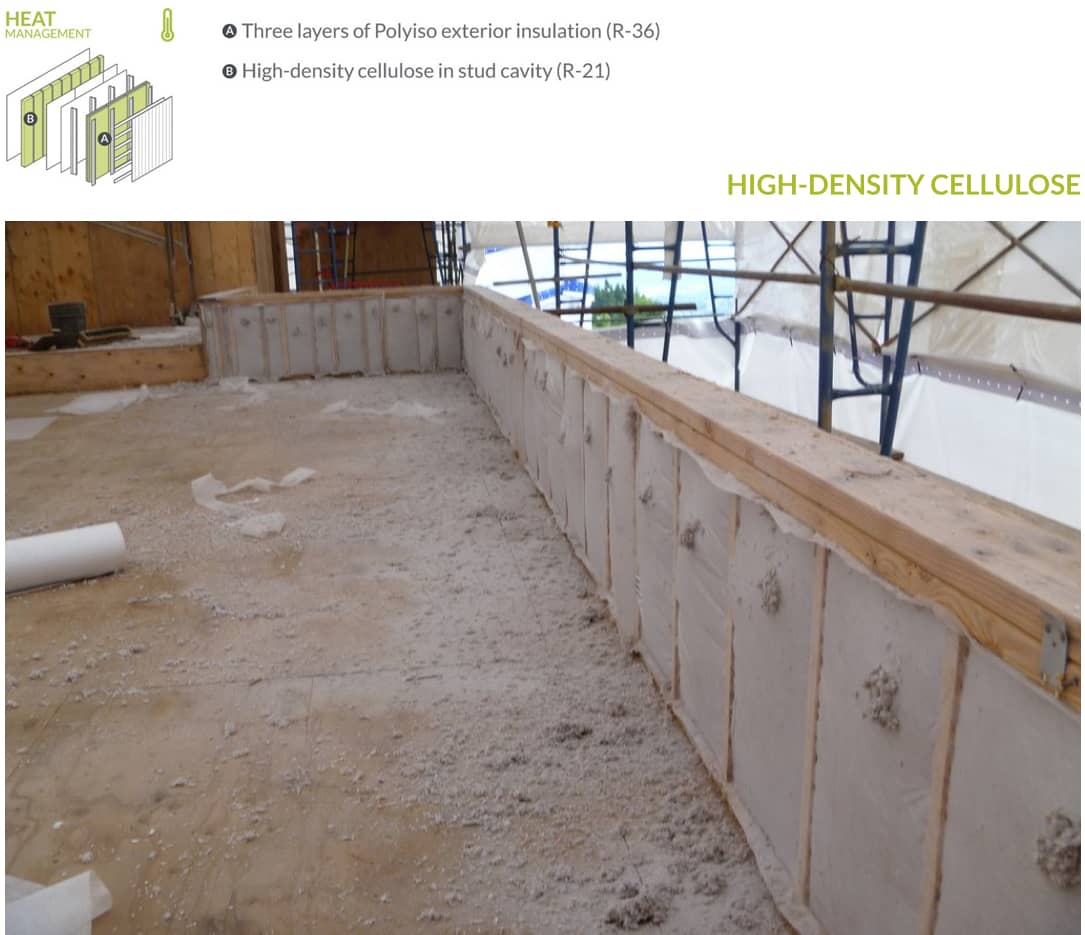
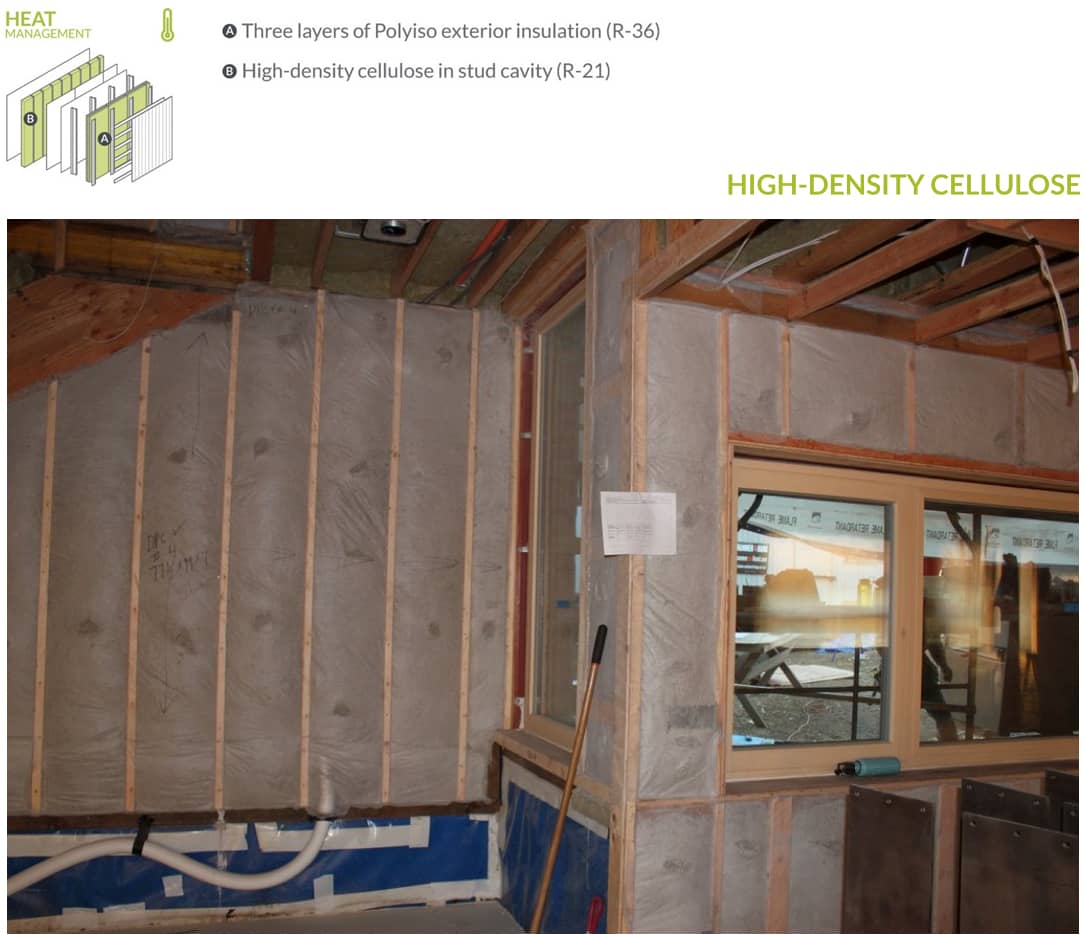
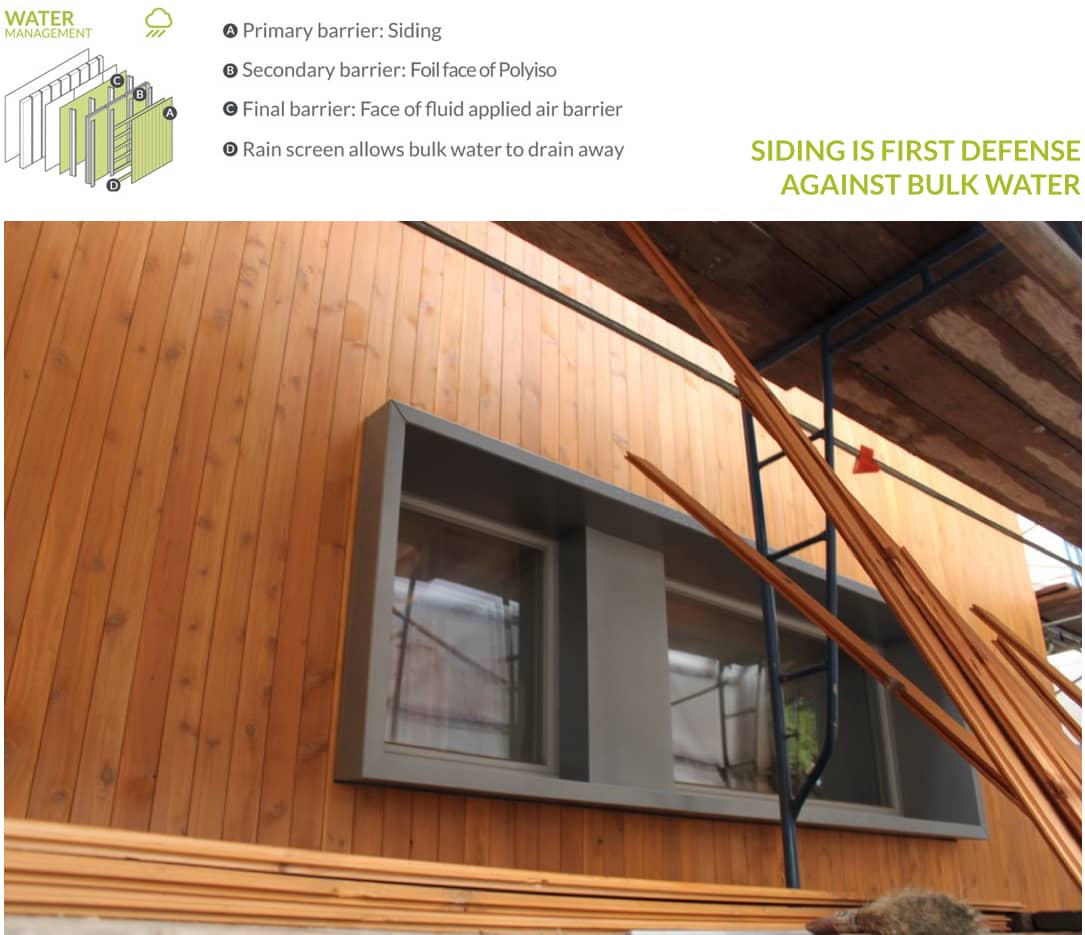
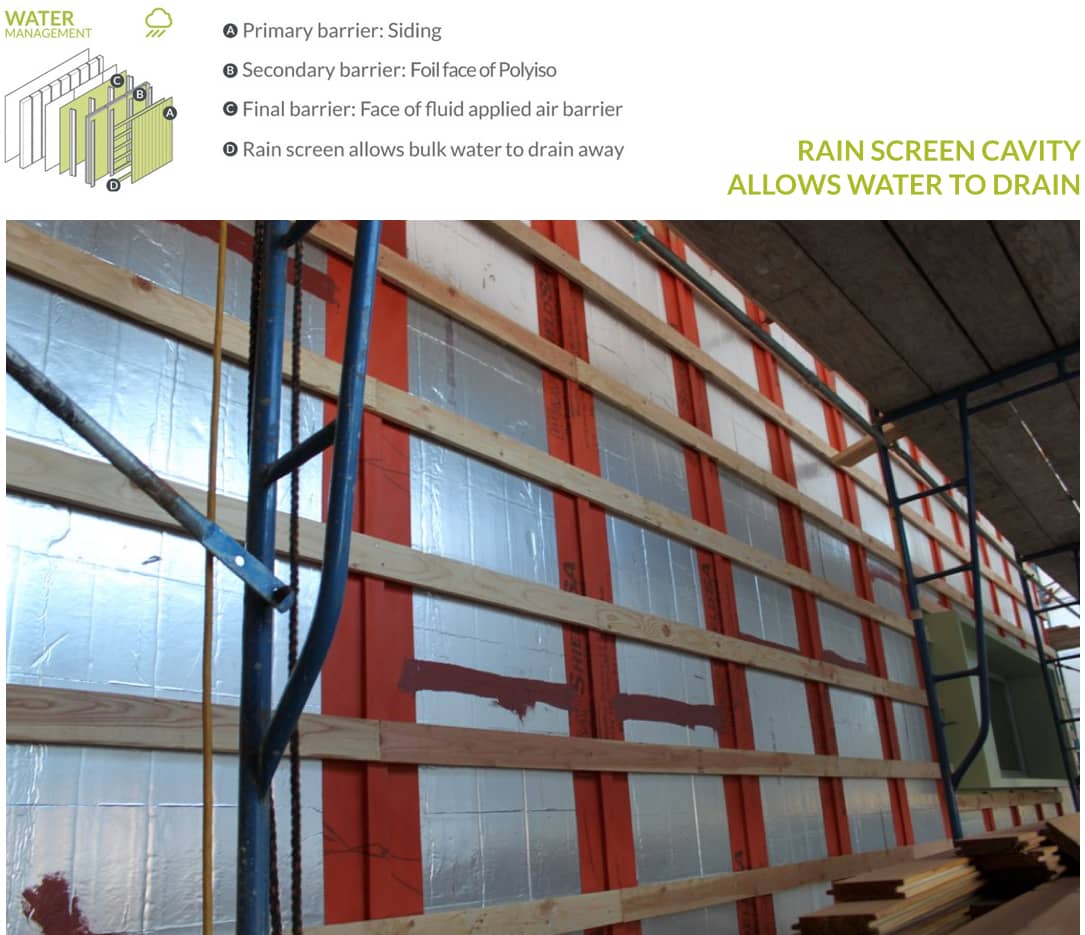
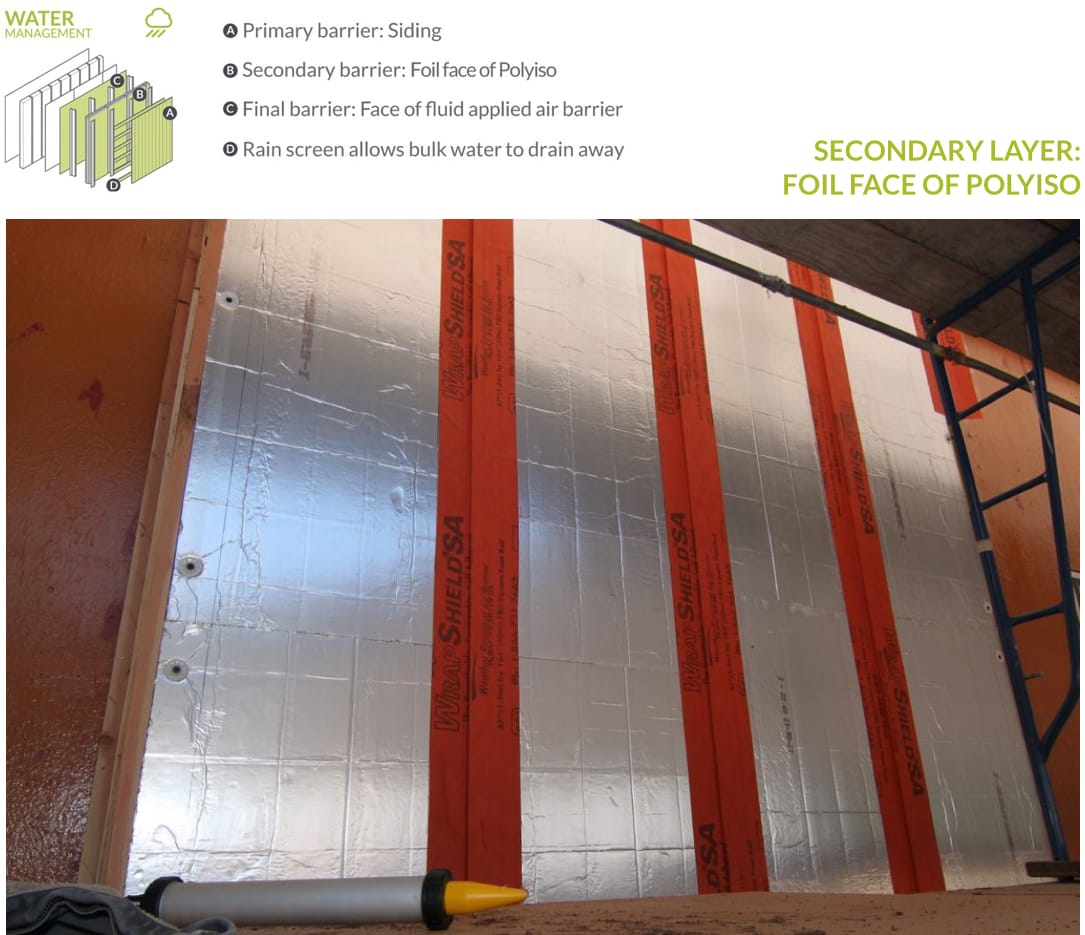
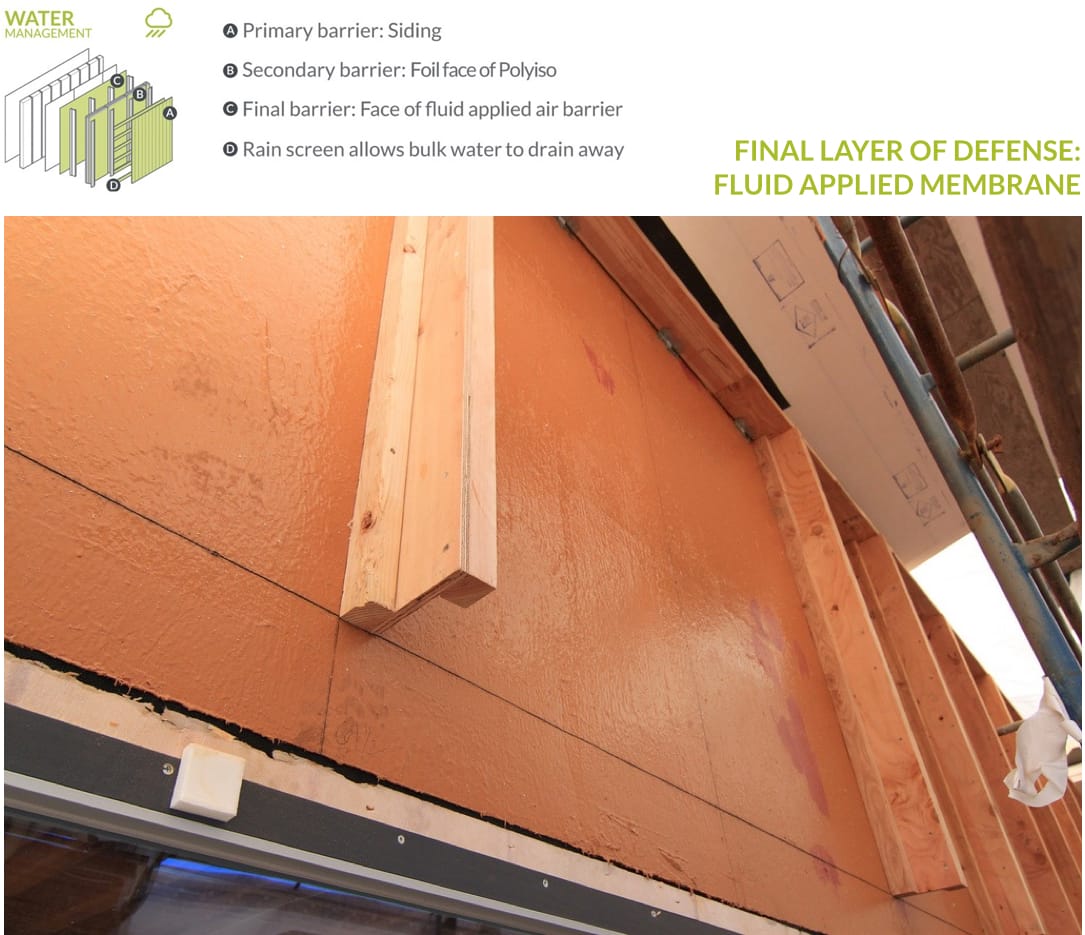
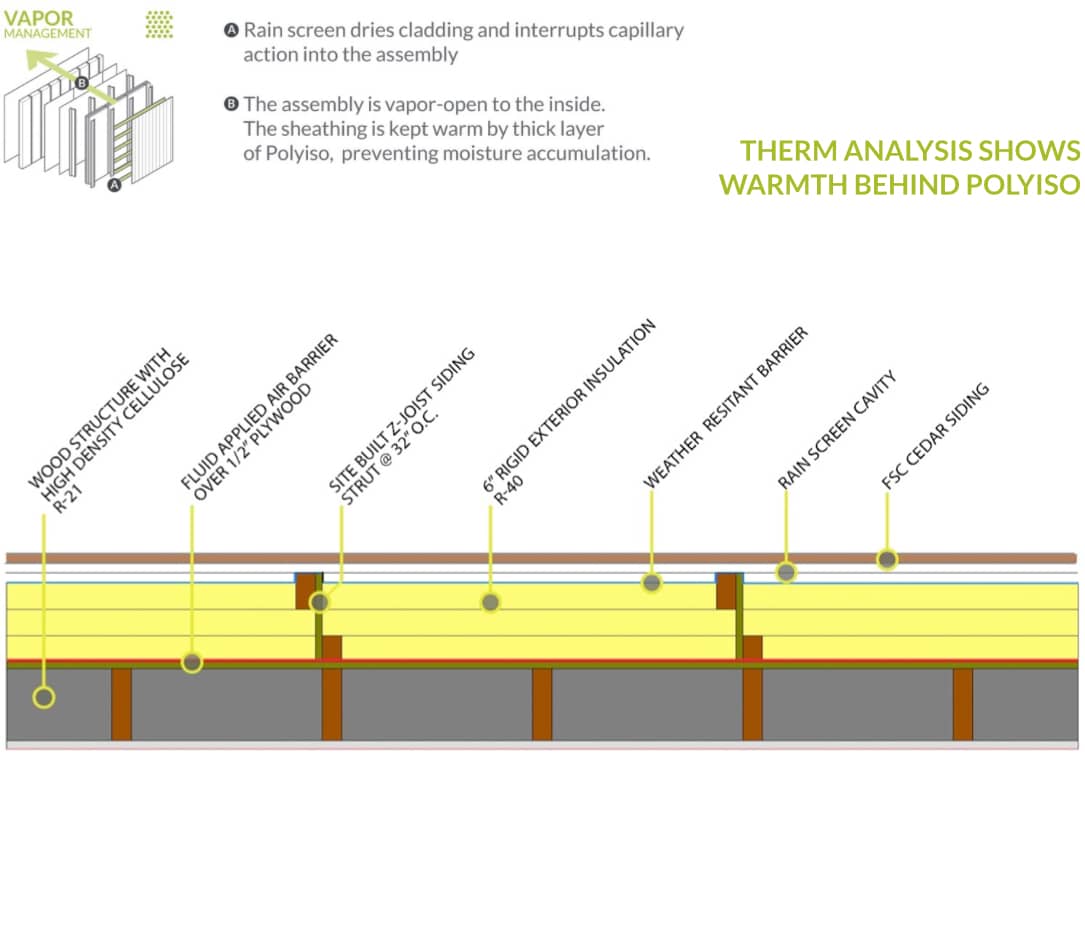
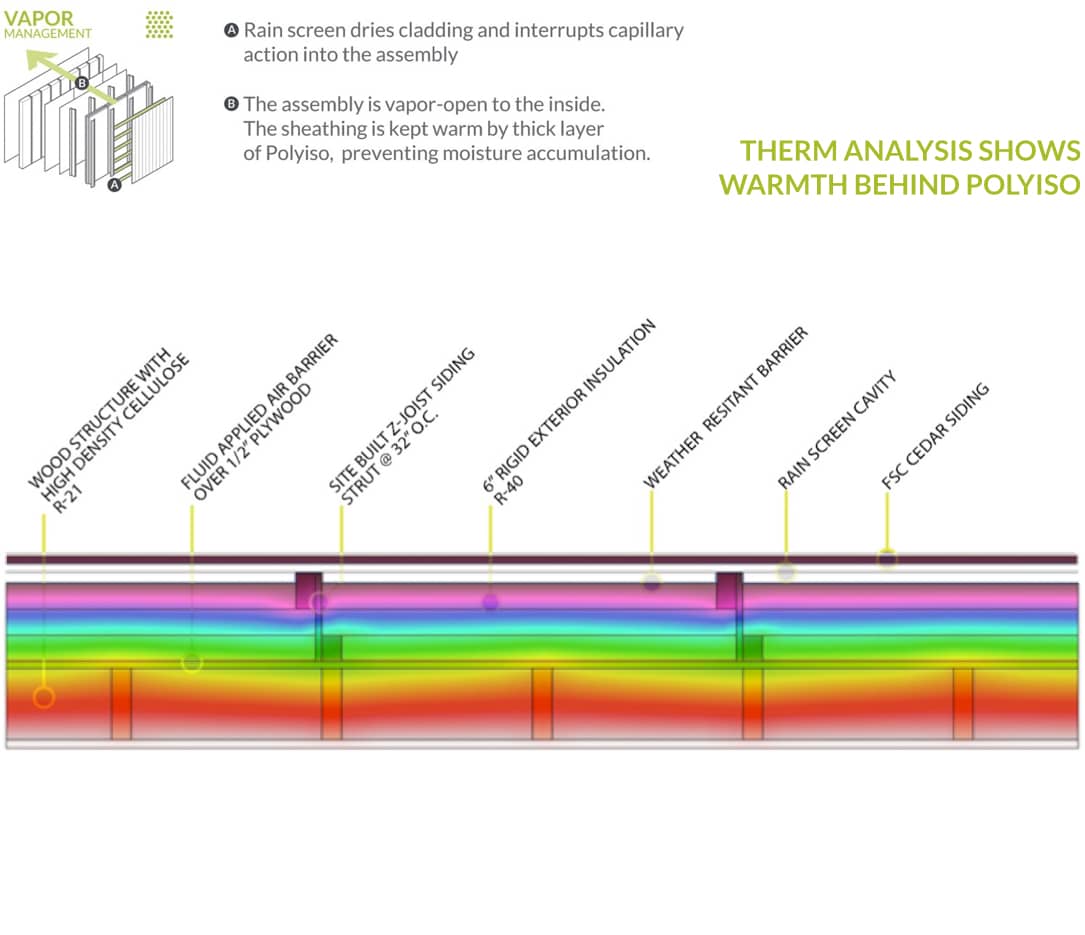
Check out the other posts in this high performance wall assembly series:
- Pumpkin Ridge Passive House Wall Assembly
- Glasswood Passive House Retrofit Wall Assembly
- Madrona Passive House Wall Assembly
Original Title: Karuna House wins a First Place Award at first-ever PHIUS Passive Projects Competition
Original Author: Zack Semke
Originally Posted on: September 21st, 2015
Bassett-Dilley. Photo courtesy of PHIUS.
At a ceremony at Chicago’s Hyatt Regency last week, Hammer & Hand’s Sam Hagerman accepted the First Place Award in the Single Family category of the inaugural PHIUS Passive Projects Competition on behalf of Karuna House and its project team: Holst Architecture (architect), Hammer & Hand (builder), Dylan Lamar (CPHC), and Earth Advantage (PHIUS+ Rater).
Passive House Institute US (PHIUS) launched the competition this year to recognize teams and projects that exemplify best passive building practices and accelerate adoption of passive building in the North American marketplace. More here.
“As a builder of passive projects, we are so indebted to the leadership and guidance of PHIUS,” Hagerman said following the ceremony. “So it’s a real honor to receive this recognition today. Credit goes to the project team for making the ambitious goals of Karuna House a reality.”
Karuna House was the first project in the world to earn the triple crown of Passive House (PHIUS+), LEED (LEED for Homes Platinum), and Minergie (Minergie-P-ECO) certification. It also earned US DOE Zero Energy Ready Home and Earth Advantage Platinum certification.
The project has garnered considerable critical acclaim as well, including:
- 2014 Beyond Green Award from the National Institute of Building Sciences
- 2014 Green Home of the Year – “Best Building Science,” from Green Builder Magazine
- 2013 Design Award, 2030 Challenge, Excellence in Residential Net Zero, from American Institute of Architects Portland.
Visit our Karuna House project page for more information about the project.
Check out our karuna house portfolio page