
Check out our bullitt center portfolio page
Original Title: Hammer & Hand’s Seattle office moves to the Bullitt Center, the noted Living Building Challenge project
Original Author: Zack Semke
Originally Posted on: August 14th, 2013
Our Seattle building and remodeling office becomes part of “greenest commercial building in the world.”
We at Hammer & Hand are happy to announce that our Seattle office is moving to the Bullitt Center, the recently-opened Living Building Challenge project on Seattle’s Capitol Hill. We started moving boxes this afternoon.

The Bullitt Center, new home to Hammer & Hand’s Seattle office (photos by Hammer & Hand)
Described as “the greenest commercial building in the world,” the Bullitt Center has become an instant paragon of green building, garnering international attention for its scope and ambition. See this video about the building by Fast Company:
Designed by the Miller Hull Partnership and built by Schuchart, the project delivers on the Living Building Challenge requirements for net zero energy, net zero water, 100% waste water treatment onsite (read, composting toilets), nontoxic materials, and a host of other deep green goals…
… at least we all think the building delivers on those requirements. A key piece of the Living Building Challenge is the monitoring of actual building performance and occupant behavior. So this first year of operation at the Bullitt Center is critical in determining whether the project truly “hits the mark.” Every electrical plug is metered, every gallon of water accounted for. Building occupants (like us) are key players in the success of Living Building Challenge projects. And I’m sure we’ll have some stories to share along the way about the experience of working in a Living Building. (The composting toilets, by the way, are pretty cool. No odor. Though a bit breezy.)

15 Avenue entrance. Green stormwater capture and treatment.
Sometimes referred to as the “moon shot” of green building, the Living Building Challenge’s requirements are grouped into seven demanding “petals”: Site, Water, Energy, Health, Materials, Equity, and Beauty. Check them out at the International Living Future Institute’s Living Building Challenge page.
As Passive House practitioners, we see Passive House and Living Building Challenge as inherently complementary certifications. The Living Building Challenge’s energy petal requires net zero energy use, and the design simplicity of Passive House provides the most direct path to reach that goal. (Step One, build a superinsulated, airtight building with heat recovery ventilation to drive energy loads very low. Step Two, add a modest amount of renewable energy. And…voila! Net zero energy.) Furthermore, because Passive House emphasizes design elegance over gadgetry, it is well-suited to achieving Living Building Challenge’s energy petal in a way that doesn’t interfere with the other petals. In a certification environment as demanding as the Living Building Challenge, the economy of means provided by Passive House is very helpful.
Living Building Challenge, in turn, provides a rich, holistic approach to green building that complements Passive House’s laser-like focus on energy performance. While Passive House is great at addressing greenhouse emissions and building durability, it intentionally puts blinders on to many other “green issues.” The Living Building Challenge tackles it all.

Hammer & Hand’s Daniel Thomas examines plans with building representatives.
The Bullitt Center is located on 15th Avenue and East Madison Street on Capitol Hill. Our space will be Suite 250, located on the second floor (which becomes the ground floor along Madison.) Nancy Burfiend of NB Design Group is the interior designer and Steve Doub of the Miller Hull Partnership is the architect for our TI (tenant improvement) of the space. As work progresses over the next couple of months we’ll use temporary desk space on the fourth floor.

H&H Project Administrator Suzanne DuBois unpacks first boxes on fourth floor.
We’re very excited, and look forward to sharing more with you soon!
– Zack

The team plans build-out of the Hammer & Hand office at the Bullitt Center.
Original Title: Our Tour of The Bullitt Center: An Intro
Original Author: Molly Donegan
Originally Posted on: October 15th, 2013
The Bullitt Center’s Brad Kahn leads Hammer & Hand through the Living Building’s systems.
(Editor’s Note: this is the first in a series of Bullitt Center tour posts by Hammer & Hand in Seattle. Please also see our posts about the Living Building’s Discovery Commons, waste management system, energy systems, and water systems.)
To date, Hammer & Hand’s Seattle office has enjoyed 3 months at the Bullitt Center, designed by The Miller Hull Partnership and built by Schuchart, housed in temporary digs on the 4th floor as we build out our suite 250 space (the countdown to occupancy has begun).
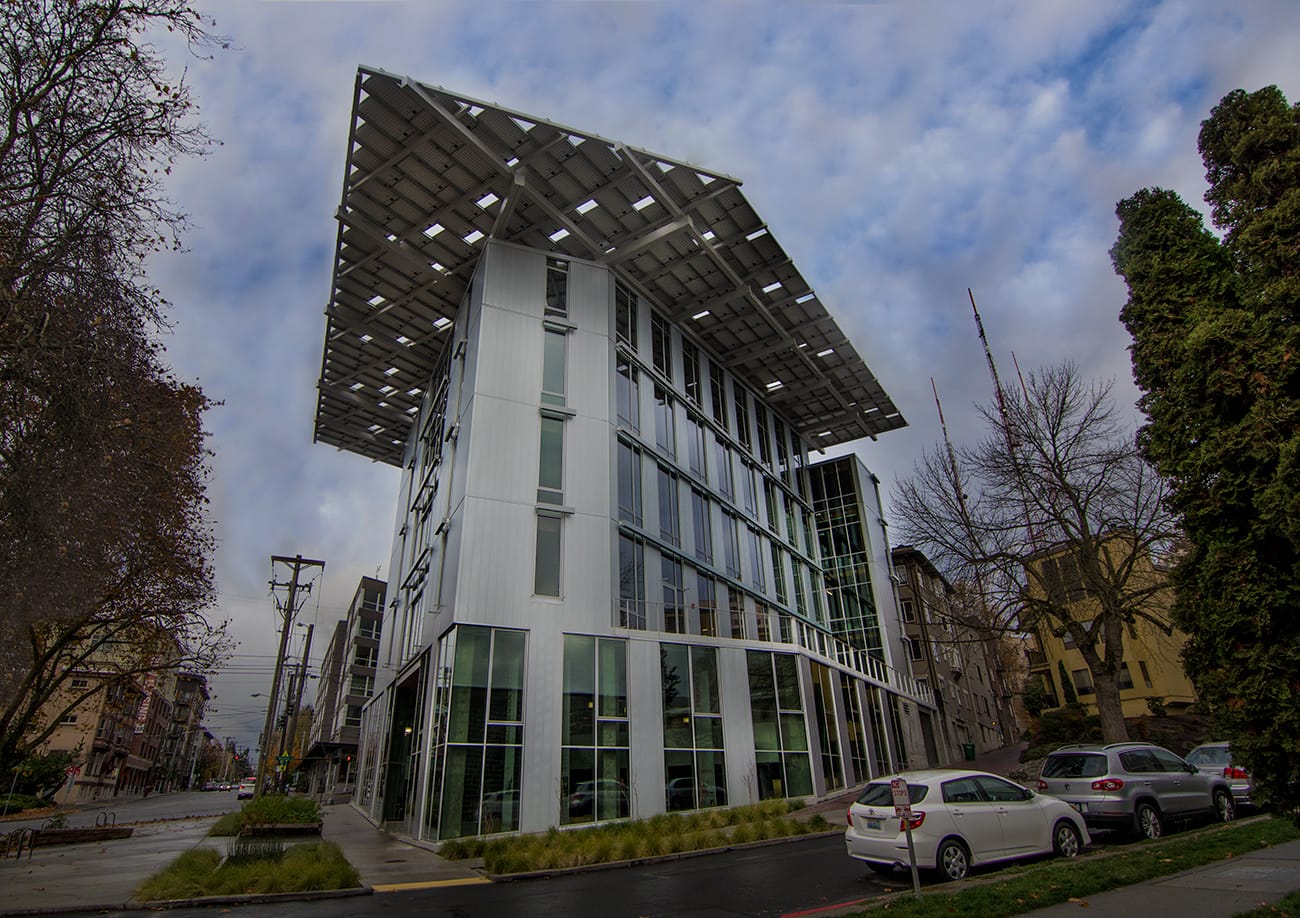
Bullitt Center Photos by Jeffrey Tan
We’ve experienced the building’s benefits firsthand: great light and fresh air, “good energy.” But many of us, myself included, hadn’t actually toured the building and the systems that allow it to claim status as the “greenest office building in the world.” That is, until our recent tour with the Bullitt Center’s Brad Kahn.
As part of his many duties in directing communications for the Bullitt Center, Brad conducts tours for all sorts of groups, from educators, to media, to policymakers. And they all start with the story of the Douglas Fir forest that once stood on this spot before it became 1501 E Madison Street in Seattle’s bustling Capitol Hill neighborhood.
That forest became a metaphor for the Bullitt Center and what the Bullitt Foundation hoped to achieve with the building. Like a Doug Fir forest, the building captures the rainwater that falls on it, uses it for its processes, and releases it back to the environment, filtered and clean. Likewise, the building derives all its energy from the solar rays that reach its roof and shine through its windows. Gray water from sinks and showers is processed onsite through engineered wetlands. Black water from toilets is transformed into compost that will fertilize gardens. Net zero water, energy, and waste: a Living Building.
This thread of biomimicry weaves throughout the building. The Bullitt Center’s array of solar panels jut out past the roof lines like a forest canopy, and like a canopy, has gaps here and there that allow sky and sun to filter through. The gaps also reveal how thin that layer of panels is, removing any misperception of heaviness or mass from the architectural detail overhead.
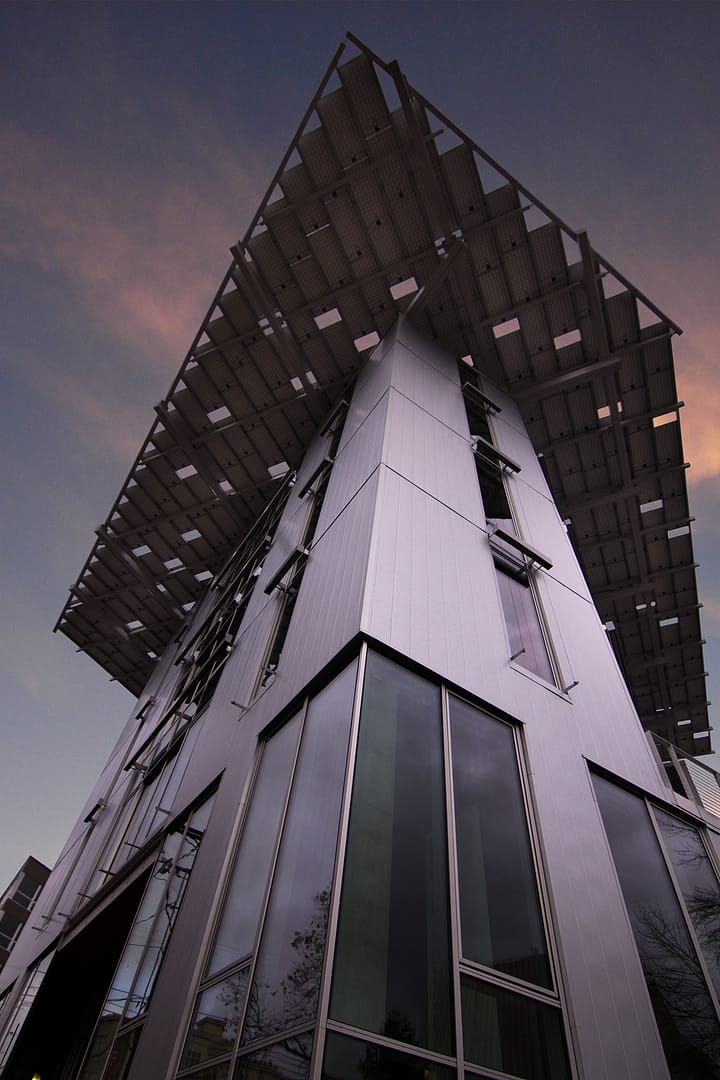
View of the Bullitt Center’s Solar Panel Roof from Below
The Bullitt Foundation selected this site for a number of reasons: its centrality; the specific height restrictions of adjacent parcels that safeguard the building’s solar access; its inclusion in the Central Area Economic Empowerment Zone; the relative lack of office space in the neighborhood; and, finally, its access to a pocket park immediately to the west of the building.
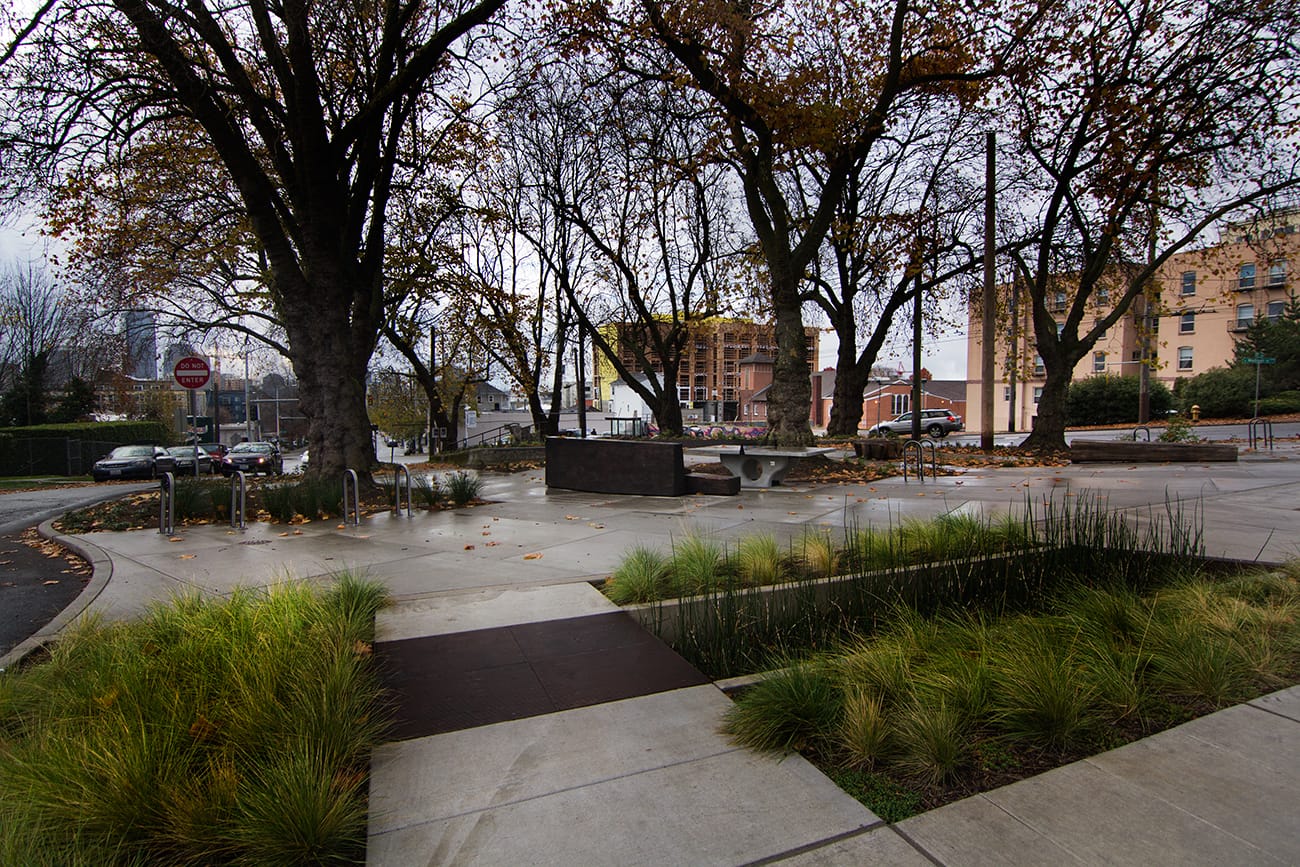
McGilvra Place Park
Technically a “street,” the McGilvra Place Park belongs to the Seattle Department of Transportation and is managed by Seattle Parks and Recreation (now with maintenance support provided by the Bullitt Center). Funded by roughly $350,000 from the Parks and Green Spaces Levy Opportunity Fund and another $350,000 from private fundraising spearheaded by the Bullitt Foundation, what was once a simple triangle of grass surrounded by mature trees has become a gathering space for the community, complete with outdoor ping pong table, bench wall, and accessible pathways. Like the Bullitt Center, the park is its own Living Building Challenge project, the first to be certified under the LBC’s “site” typology.
More to follow soon…the tour will go inside for the next post.
– Zack
Connect with me at +ZacharySemke
Original Title: At Home in the Bullitt Center: Hammer & Hand’s Office Build-Out
Original Author: Laura Grange
Originally Posted on: September 17th, 2014
Working on the tenant improvement of Hammer & Hand Seattle’s Bullitt Center office had its challenges. Every material used in the Bullitt Center must adhere to Living Building Challenge green building requirements, which meant a lot of back-and-forth to make sure the materials we used in our office build-out were up to snuff. In the video below, H&H Project Administrator Suzanne DuBois discusses the process of choosing materials:
Our office features many cool (if I do say so myself) design details, many of them serving dual purposes, like the Gray Echo Eliminator panels made of recycled cotton on the wall in the photo below:
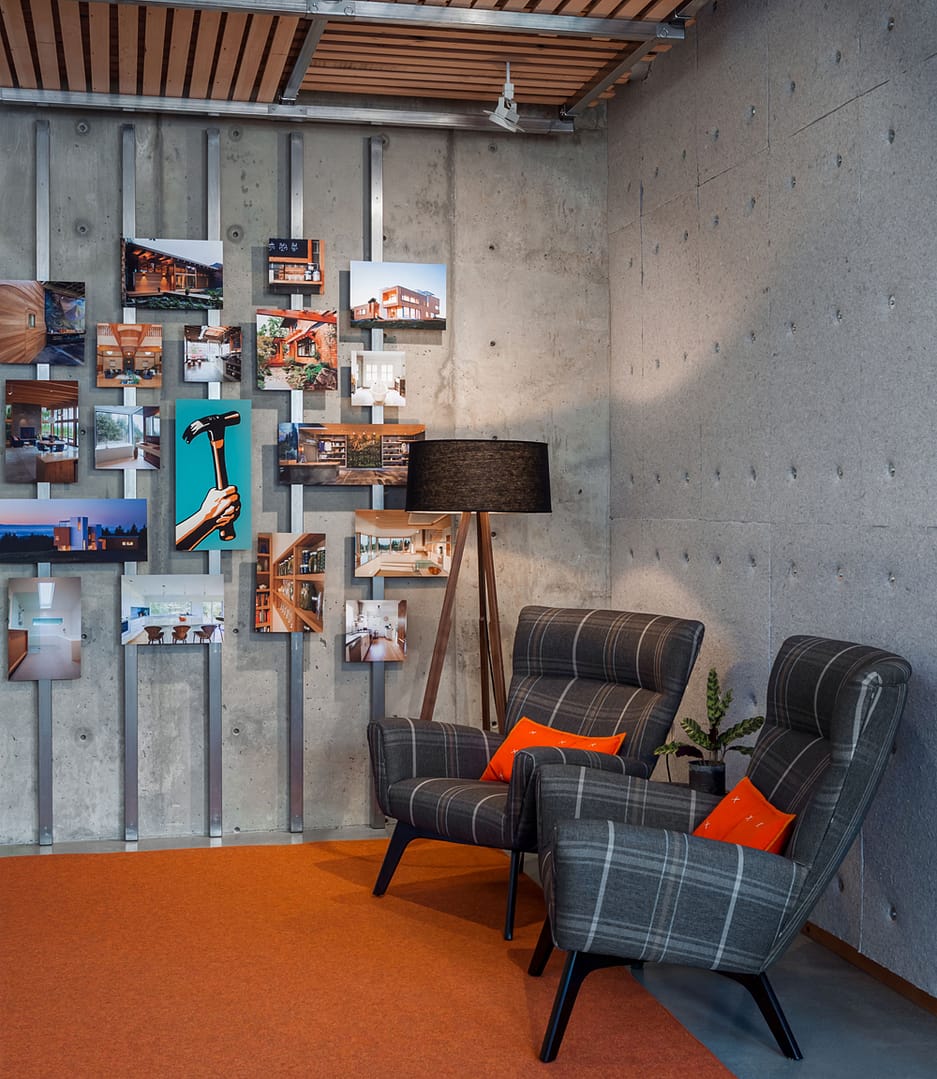
As Suzanne mentioned in the video, these panels make both a visual and aural impact on the space, providing sound absorption to what was a very reflective box of concrete floor, walls, and lid. By covering the ceiling and the front entrance accent wall with the recycled cotton the space stays nice and quiet.
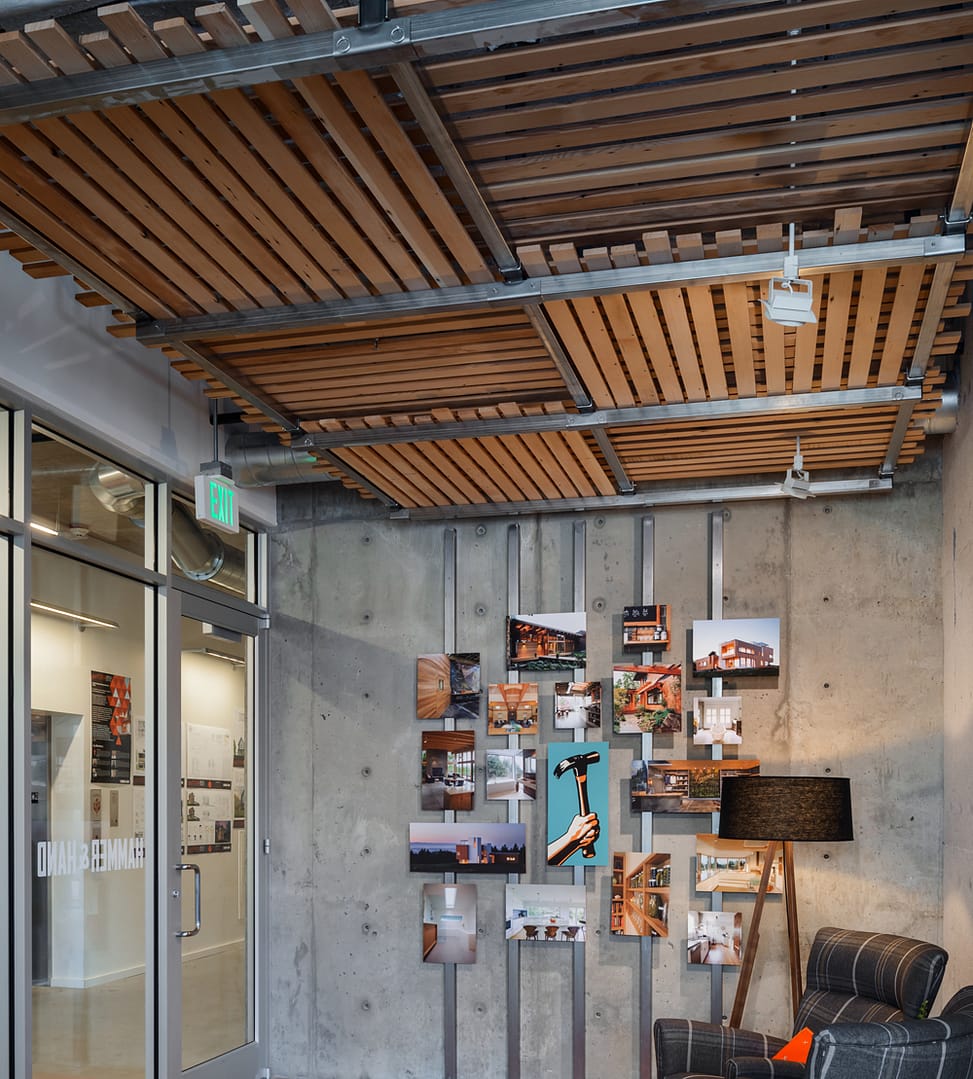
Two other fun design elements are the gallery wall and the drop ceiling. Photos of a few of our past projects adhere magnetically to steel beams running the length of the wall. It’s almost like a game of Tetris laying out the images and really personalizes our entry. The drop ceiling of salvaged lumber is a nod to our tradition of upcycling and adds a fun design element to the ceiling in our entry and conference room.
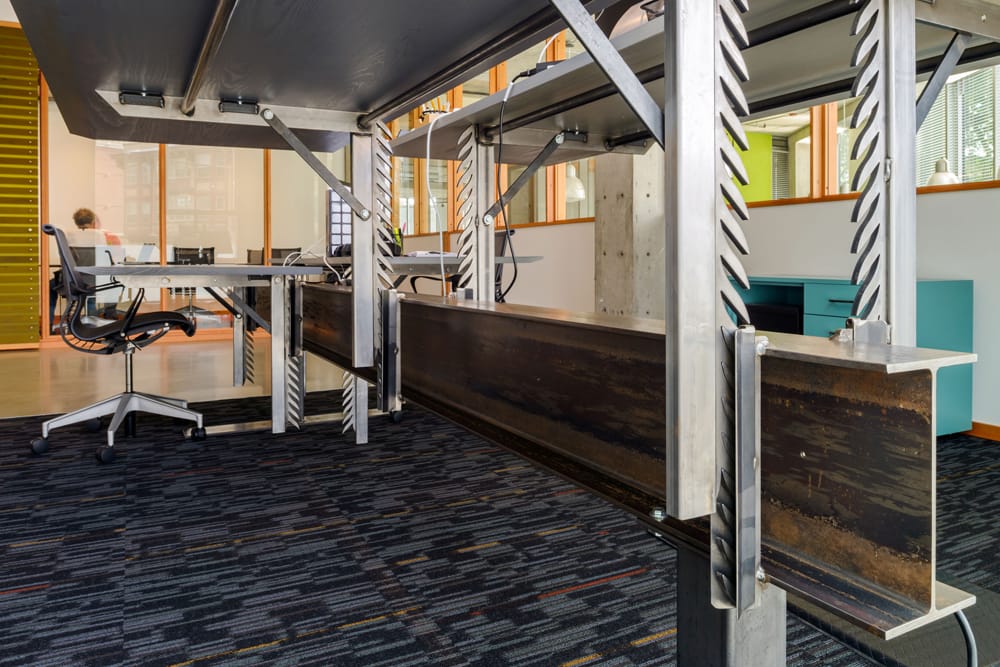
When you work in the Bullitt Center, with access to lots of natural light and views of the city, you don’t block it out with boring cubicle walls. In fact, the Living Building Challenge carries with it an imperative to leave interior views to windows unobstructed. To that end, our desks have an open design, with bases custom made by Brian Parnell of Parnell Design and Fabrication of industry-appropriate I-beams. The tabletops can be adjusted for either a sitting or standing desk configuration. Our Portland woodshop crafted the tabletops out of FSC®-certified wood.
Like our desks, we wanted our conference room to have a little something special. H&H Shop Manager Dan Palmer and carpenter Josh Tinker built a custom door — designed by Nancy Burfiend of NB Design Group — in our Portland woodshop for the space. The door, weighing in at an impressive 300 pounds and standing 10 feet tall, acts as a statement piece as well as an entrance to the conference room. The wood used for the door is reclaimed Douglas Fir from one of our past commercial projects (Glasswood Passive House Retrofit). The wood is bolted across green-toned 3form acrylic resin (a material that is 37% recycled content and pre-approved by the Bullitt Center).
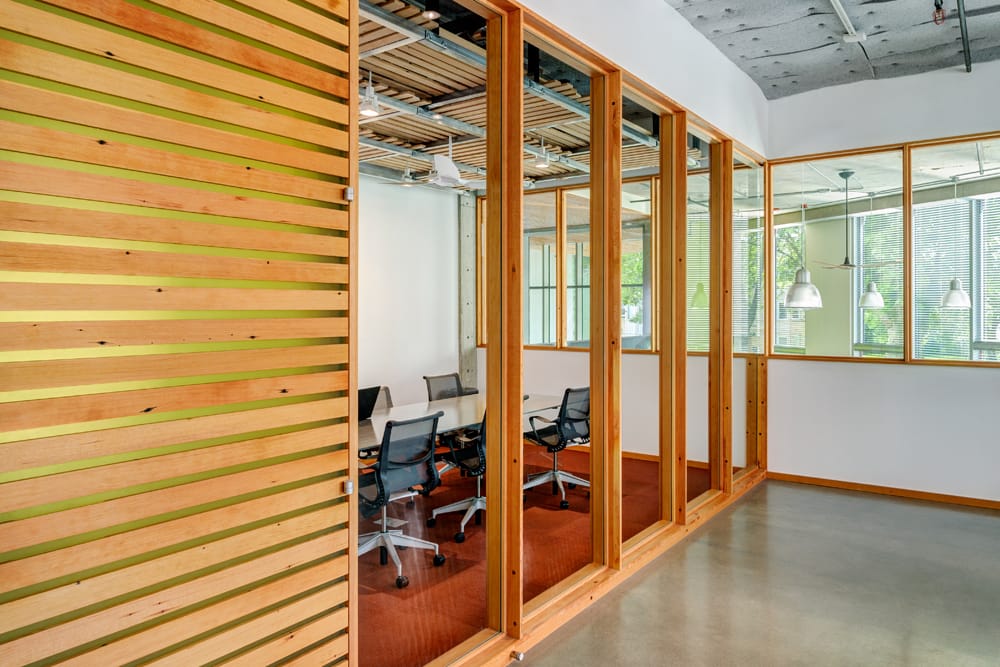
In the video below, H&H Co-Owner and CEO Daniel Thomas and Shop Manager Dan Palmer discuss the construction and design details behind the door:
P.S. Have questions for us about what it’s like to work in the Bullitt Center? Leave them in a comment below and we’d be happy to answer them!
Check out our bullitt center portfolio page