Today’s story, “Building Homes That Withstand The Cold” explains the energy-efficient building standard and explores how it can help transform North America’s built environment.
Passive House is in the news again today, with a radio story by “Here & Now” broadcast on public radio stations across the country, including our own Oregon Public Broadcasting. The story interviews Boston-based Jordan Goldman of Zero-Energy Design, who touched on a number of key Passive House takeaways:
- No need to sacrifice. Passive Houses leave lots of design flexibility and enable high “thermal comfort” with a small-footprint. Superinsulation, airtightness, and mechanical ventilation mean you can set the thermostat at a comfortable level and still save 75-90% energy vs. conventional buildings.
- Smart upfront investment. Goldman estimates that Passive House projects cost an average of 10% more than conventional homes to design and build. This modest (albeit not-insignificant) increase in cost buys huge energy savings for the lifetime of the home as well as the reduced carbon footprint that comes along with those savings. And the increased cost is partly due to builders’ and designers’ learning curve, a curve that will be overcome with time and experience.
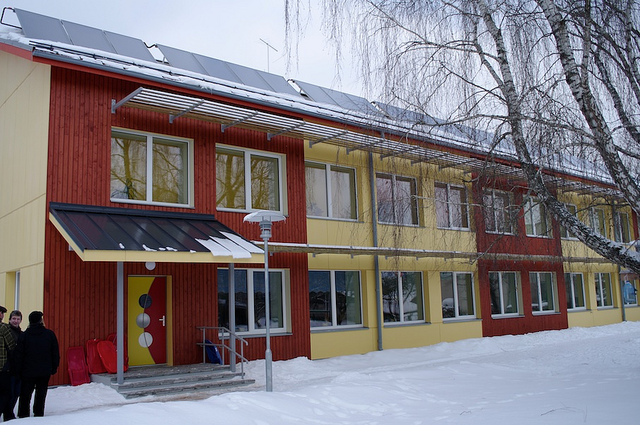
- Not just for houses. Passive House derives from the German term Passivhaus, but can apply to any building, not just residential structures. Commercial, institutional and industrial buildings can be built to the standard, for instance. Goldman points out that Passive House technology, with its constant source of fresh air ventilation, is particularly well-suited to school construction because it can provide high indoor air quality. The image below by Tonu Mauring shows a Kindergarten in Estonia built to the Passive House standard.
– Zack (Connect with me at +ZacharySemke)